

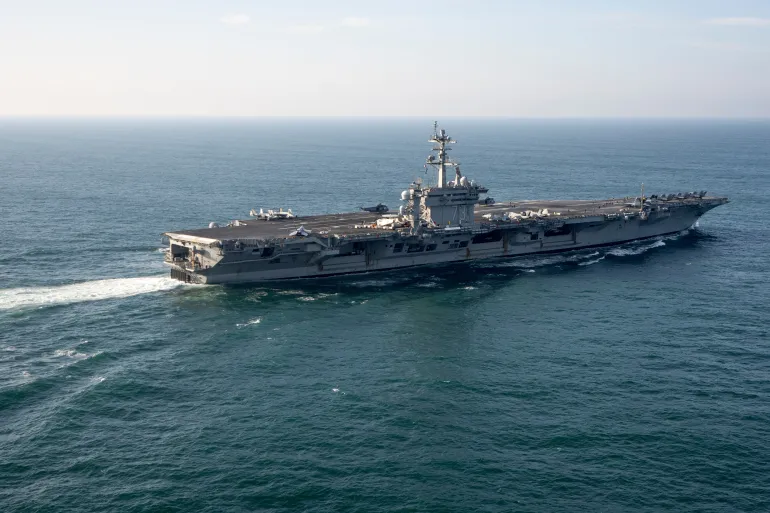
United States allies across the Asia-Pacific region are expressing growing unease as the Trump administration shifts critical military resources to the Middle East. This redeployment comes as the US-Israel war against Iran enters its sixth month, forcing Washington to balance global commitments while maintaining its strategic posture in Asia.
The most significant shift involves the USS George Washington, the final US aircraft carrier previously stationed in Japan, which has been ordered to the Middle East. It is tasked with relieving the USS Abraham Lincoln, a vessel that has spent nine months on continuous deployment amid reports of deteriorating conditions, including food shortages, poor sanitation, and sailor distress. Earlier this year, the US also relocated components of its Terminal High Altitude Area Defence (THAAD) system from South Korea to the Middle East and drew down regional missile and munitions stockpiles to sustain the war effort.
William Yang, a senior analyst for Northeast Asia at the International Crisis Group, warned that these cumulative moves weaken US power projection. He noted that the departure of the USS George Washington impacts the effectiveness of regional deterrence against China. According to Yang, this trend is particularly alarming as Chinese coastguard activity has intensified since June in waters east of Taiwan, overlapping with the exclusive economic zones of Japan and the Philippines. He described these maritime operations as targeted maneuvers aimed at Taipei, Manila, and Tokyo, designed to test US resolve and response capabilities.
Political scientist Ja Ian Chong from the National University of Singapore observed that the shift might embolden Beijing. He suggested that allies are questioning whether the reduced US presence invites China to push boundaries, thereby increasing pressure on regional partners. While the US maintains a significant footprint in the region—with approximately 375,000 military and civilian personnel assigned to the US Pacific Command—Chong views the redeployment as a symbolic shift toward a strategy where allies are expected to lead their own defense with US support.
This strategic pivot aligns with the 2026 National Defense Strategy, which emphasizes increased burden-sharing. The policy mandates that allies in Asia and Europe raise military spending to 3.5 percent of their GDP and security-related expenditures to 1.5 percent by the 2030s. In response, Taiwan has announced plans to boost defense spending by 18 percent in 2027, while Philippine Defense Secretary Gilberto Teodoro Jr. has advocated for raising his nation’s defense budget to 4 percent of GDP.
Despite the current anxiety, some experts remain cautious about interpreting these moves as a permanent withdrawal. Kei Koga of Nanyang Technological University acknowledged that while the redeployment is concerning in the short term, it does not necessarily signal a long-term strategic disengagement. Similarly, K Tristan Tang, a fellow at the National Bureau of Asian Research, pointed out that key assets like US Amphibious Ready Groups, capable of hosting F-35B stealth fighters, remain in the theater.
Tang further argued that the Trump administration remains fundamentally focused on its primary geopolitical rival. He noted that despite the demands of the Iran conflict, the president’s core priority remains US economic interests and the strategic competition with China. As Tang put it, China remains the most important factor in Washington’s long-term calculus, and experts generally expect US interest and naval assets to eventually return to the Asia-Pacific theater. The report also notes that reports suggested that at least one sailor tried to jump off board. The report also notes that which runs from north of Japan through Taiwan and the northern Philippines to Borneo, while the last US aircraft carrier has left the area – for now – the Chinese fleet has increasingly ventured beyond the First Island Chain. The report also notes that but it has recently done little to keep China’s Liaoning and Shandong aircraft carriers from moving into the Western Pacific, the Cold War defensive line was originally designed to contain Beijing. The report also notes that “Part of it is also testing the US reaction to these operations and the US capability to respond.”. The report also notes that “I think US allies and partners may wonder if the move gives [China] more confidence to test and push. The report also notes that that could in turn put more pressure on them,” he told. The report also notes that although US allies could still take comfort in the fact that the lion’s share of US forces remain in the region, chong said the aircraft carrier’s redeployment has reduced some US operational flexibility. The report also notes that he expected to see this trend deepen as Asia navigates its way forward, chong said that going forward.