

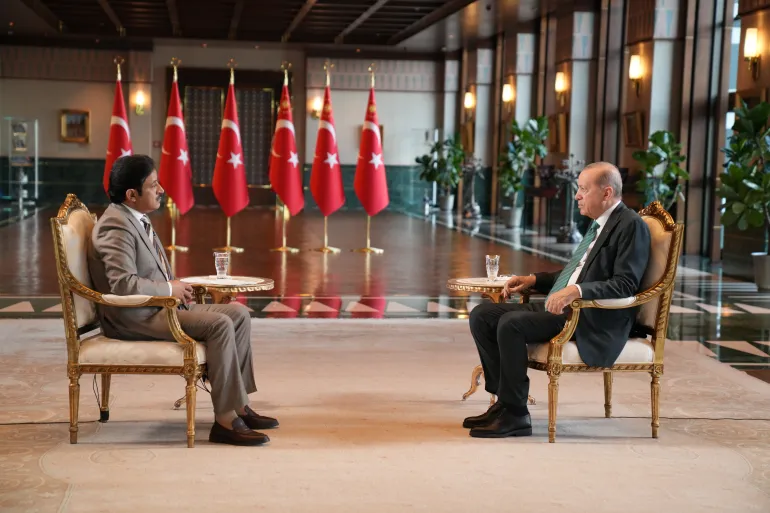
Turkish President Recep Tayyip Erdogan has indicated that Egypt could potentially join the joint defence agreement recently signed by Turkiye, Saudi Arabia, and Pakistan. In an exclusive interview for Al Jazeera’sAl Muqabala(The Interview), Erdogan described Cairo’s future accession as “possible,” emphasizing that the framework remains open to additional members.
The agreement, formally known as the Mecca Pact, was signed last Friday in the holy city by Erdogan, Saudi Crown Prince Mohammed bin Salman, and Pakistani Prime Minister Shehbaz Sharif. It includes a collective-deterrence provision stipulating that an armed attack against any one of the three signatories would be treated as an attack against all of them. While analysts have drawn parallels to NATO’s Article 5, officials in Islamabad have urged caution against viewing the deal as a direct equivalent to the Western military alliance or as a pact directed at any specific nation.
“This agreement has sent an important message to the world,” Erdogan said, noting that Egypt’s participation is among the options currently being considered for the pact’s future expansion.
During the interview, Erdogan addressed a broad range of regional crises, including the ongoing wars in Syria, Gaza, and Lebanon, as well as tensions surrounding the Strait of Hormuz. He emphasized that reopening the strait is a priority for Ankara, arguing that its continued closure serves no party’s interests. Furthermore, he credited Qatar with playing an essential role in mediation efforts aimed at halting the fighting across the region.
Regarding the humanitarian catastrophe in Gaza, Erdogan stated that Turkiye “cannot leave Gaza alone” and is prepared to do whatever is necessary to support the territory. He asserted that Hamas has been meeting its commitments in good faith, while criticizing Israel for the continuation of its military campaign.
The president also addressed the situation in Syria and Lebanon, pledging that Turkiye would not abandon its neighbors to regional turmoil. He expressed his intention to visit Syria to support stability, noting that he expects the country’s Kurdish population to share in a future of peace. Regarding Lebanon, he highlighted his recent discussions with US President Donald Trump, stressing that Washington must play a decisive role in bringing the Israeli attacks to an end.
On the diplomatic front, Erdogan noted that Ankara’s relations with Libya remain stable and that Turkiye remains committed to its support. He also affirmed his strong ties with the head of Sudan’s Sovereignty Council, Abdel Fattah al-Burhan, promising continued support for the nation. Conversely, he signaled a shift in policy toward the European Union, stating that membership is no longer a priority for Ankara and that Europe would ultimately be the “loser” for its reluctance to admit Turkiye.
The president also addressed the status of the F-35 fighter jet program, stating he had received a promise from Trump regarding the aircraft and was waiting for it to be honored. Turkiye was removed from the multinational F-35 program in 2019 after acquiring the Russian-made S-400 air defense system, which Washington argued could compromise the jet’s stealth technology. During the NATO summit in Ankara last month, Trump suggested his administration would lift the CAATSA sanctions imposed on Turkiye in December 2020, describing a return to the F-35 program as “something certainly we’d consider.”
Despite these diplomatic overtures, any potential sale continues to face significant resistance in the US Congress. A 2020 law currently bars the Pentagon from transferring F-35 technology to Turkiye as long as the country retains the S-400 system.