

President Donald Trump has filed an emergency petition with the Supreme Court, seeking to overturn lower court orders that blocked construction of a $400 million ballroom at the White House. The administration argues that the project, which has faced repeated legal setbacks, is essential for national security and the president’s personal safety.
The legal challenge follows a ruling last week from a Washington, DC, appeals court, which determined that the president lacked the unilateral authority to proceed with the East Wing expansion without congressional approval. While the court ordered an immediate halt to the project, it granted a 14-day stay to allow for this appeal to the justices. This marks the first time one of the president’s major infrastructure initiatives has reached the high court.
US Solicitor General John Sauer, representing the administration, contended that the construction is vital for the president’s protection, particularly in light of recent assassination attempts. Sauer argued that the injunction represents “judicial overreach beyond the proper province of the federal courts,” asserting that the president, as the elected head of the Executive Branch, possesses the authority to secure and renovate the White House grounds. The administration maintains that Congress has already granted the president power to make improvements as he deems necessary.
The legal battle was initiated last year by the National Trust for Historic Preservation. In its 2-1 decision on August 7, the DC Circuit Court of Appeals sided with the trust, stating, “Whether or not a massive ballroom should be constructed is for Congress to decide and is not a matter for Executive self-help.” The court emphasized that the president does not have unfettered authority to reshape the “People’s House” to suit personal preferences.
While the courts have halted above-ground work, they have permitted the continued construction of a highly sophisticated underground security bunker. However, the administration argues this partial stop is insufficient, claiming that leaving the 70-foot concrete-and-steel superstructure unfinished poses a “major safety risk” due to structural instability. Sauer noted that the current progress cannot be left unattended without compromising the integrity of the build, further complicating the Secret Service’s ability to secure the site.
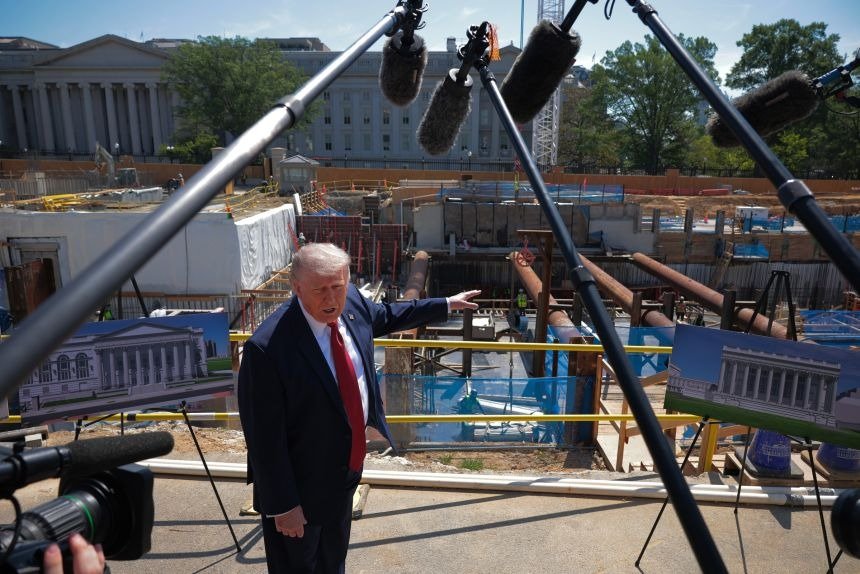
New renderings submitted to the Supreme Court reveal aesthetic updates, including the addition of large gold presidential seals. Critics, including sources familiar with DC historical planning, have expressed concern that these additions clash with the White House’s traditional “restrained aesthetic of republican simplicity.” The project, which architect Shalom Baranes estimates at 89,000 square feet—significantly larger than the 55,000-square-foot Executive Mansion—is slated for completion in the summer of 2028.
The filing also highlights the architectural inspiration behind the ballroom, which includes Corinthian columns crafted from high-grade Indiana limestone currently being carved in Italy. As the administration pushes for a resumption of work, the National Trust for Historic Preservation has until noon on Tuesday to file its response to the petition. The outcome will determine whether the president can continue his efforts to complete the massive expansion before his term concludes. The report also notes that the emergency request filed Friday comes after lower courts repeatedly ruled that Trump needed approval from Congress before moving forward with the $400 million project. The report also notes that but the court paused implementation of its decision for 14 days to give Trump time to appeal to the justices. The report also notes that lower courts sifting through a litany of cases challenging his plans to remake Washington have looked skeptically at his arguments defending his approach or issued rulings frustrating his pursuits, in recent months. The report also notes that “The entire ballroom structure is designed to shield the military installation beneath it,” Sauer wrote, “Halting the Project will stall this vital construction, making this President — the subject of recurrent assassination attempts — much less safe, and risking future Presidents’ safety.”. The report also notes that including a tower crane, images posted by Trump in early August reveal multiple levels of concrete support columns and metal rebar amid a significant amount of construction equipment. The report also notes that from floor plans to marble selection, the president has been personally involved in ballroom details. The report also notes that the sprawling ballroom project has an estimated size of approximately 89,000 square feet, according to lead architect Shalom Baranes. The report also notes that trump has maintained that the project isn’t subject to any oversight and that he should be able to continue with it without any serious scrutiny.