

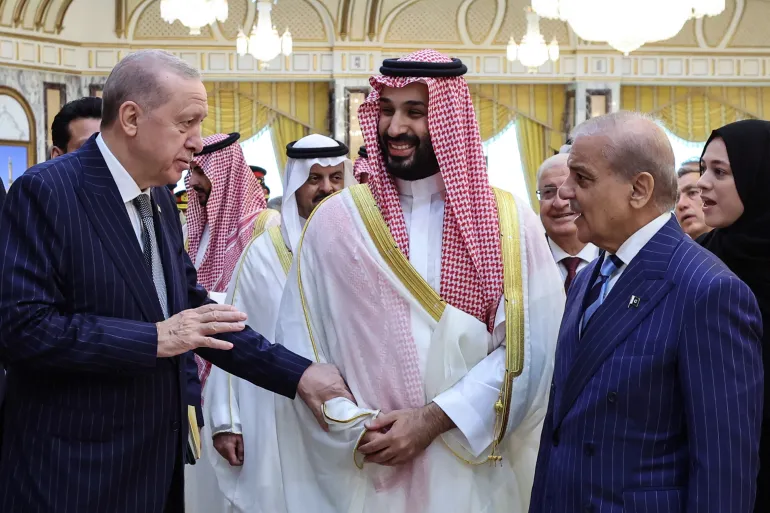
A significant geopolitical shift occurred on Friday as Turkiye, Saudi Arabia, and Pakistan formalized a mutual defence agreement. Known as the Mecca Joint Defence Pact, this coalition seeks to establish a framework for collective security, though its practical application remains a subject of intense debate among regional observers. The agreement emerges at a time when the Middle East is navigating profound instability. The regional order has been under immense pressure since the October 7, 2023, Hamas attack on Israel and the subsequent military campaign in Gaza, which fundamentally altered the security calculus for many nations.
Experts have speculated that the deal may mark the beginning of a wider regional alliance that sits between Israel and Iran, wary of both. While the signatories seek to project a message of strength and unity in the face of regional threats, they have also been cautious about framing the pact as a deterrent. Analysts note that the three countries have been cautious not to antagonise regional adversaries, leaving the extent of their military commitment open to interpretation.
Harlan Ullman, chairman of the Killowen Group, noted the ambiguity inherent in the pact’s language. “We believe it says an attack on one should be considered an attack on all — and ‘should be’ is the operative phrase because that does not mean ‘necessarily’,” Ullman told Al Jazeera. He added that it remains unclear how the Mecca Joint Defence Pact might pull its three signatories into any of the various conflicts currently simmering across the region.
The threats are not distant. Pakistan has been engaged in a border conflict with Afghanistan since February, and it exchanged fire for several days with fellow nuclear power India in May 2025. Saudi Arabia, meanwhile, has repeatedly come under attack from Iran and its regional proxies since the outbreak of the United States-Israeli war. Turkiye has similarly fought Kurdish armed groups both inside and outside its borders for years, while its diplomatic tensions with Israel have escalated significantly.
“Supposing the Houthis in Yemen attack Saudi Arabia, does that bring in Turkiye? Does that bring in Pakistan? That remains to be seen,” Ullman said. The Middle East has experienced significant upheaval in recent years, and decades of threats between Iran and Israel have culminated in a regional war that has yet to end. Countries across the region are now trying to figure out how to deal with the chaos and prepare for the next phase of instability.
Many of these states appear to be putting past differences behind them, deciding that pragmatism is the best path forward. Turkiye and Saudi Arabia are prime examples. The 2018 murder of Saudi journalist Jamal Khashoggi in his country’s Istanbul consulate led to a deep rift that lasted for years. However, by 2022, Riyadh and Ankara were seen to put aside their past differences, with the former pursuing a region-wide de-escalation strategy and the latter looking to strengthen its economy.
That pressure is understood to have helped push Pakistan, Saudi Arabia, and Turkiye together. The Mecca Joint Defence Pact aims to serve as a deterrent to any threat the three countries may face. As Al Jazeera correspondent Osamah Bin Javaid pointed out, each side brings a different strength to the table. “Each of these countries brings unique capabilities: Pakistan’s battle-hardened military, its munitions and nuclear arsenal, the only one in a Muslim-majority nation,” Bin Javaid said.
Turkiye, a vital NATO member, brings world-class drone technology and sophisticated defence manufacturing. Saudi Arabia provides the financial and strategic depth necessary to sustain such a coalition. The need for new military alliances has been amplified amid questions about the reliability of the United States. As foreign policy in the US grows increasingly erratic under President Donald Trump, countries across the world are calling for greater self-reliance.
Experts also point out that Israel appears to be the US’s top foreign-policy priority in the Middle East, leading to concerns about Washington’s long-term commitment to its other regional partners. “The Trump administration has said that allies have got to fend for themselves,” Ullman said. “It’s clear to me that our allies are looking elsewhere.” This sentiment underscores the strategic pivot behind the new pact.
While Israel and Iran have shown themselves to be regional threats, the signatories to the Mecca Joint Defence Pact have been careful to maintain a degree of diplomatic flexibility. For all three states, Israel remains the biggest threat to regional security and stability, according to Bin Javaid. Iran closely follows within that threat matrix, especially for Saudi Arabia after Tehran’s attacks on Washington’s interests.
For many in the region, Israel, which once pushed for the normalisation of ties with Saudi Arabia, has demonstrated post-2023 that it is more interested in settling differences using military power than negotiations. Israeli Prime Minister Benjamin Netanyahu has also begun to speak of the dangers of an emerging “Sunni axis,” though he has not defined what that might be. Meanwhile, other regional actors like Syria remain focused on post-war reconstruction after a brutal 13-year conflict.
Ultimately, the effectiveness of the Mecca Joint Defence Pact will be tested by the very conflicts it seeks to avoid. Whether it functions as a robust military alliance or merely a symbolic gesture of unity remains to be seen. As the regional order continues to fracture, the signatories will have to balance their newfound collective security goals against the complex, often contradictory, interests of their neighbors and global powers.