

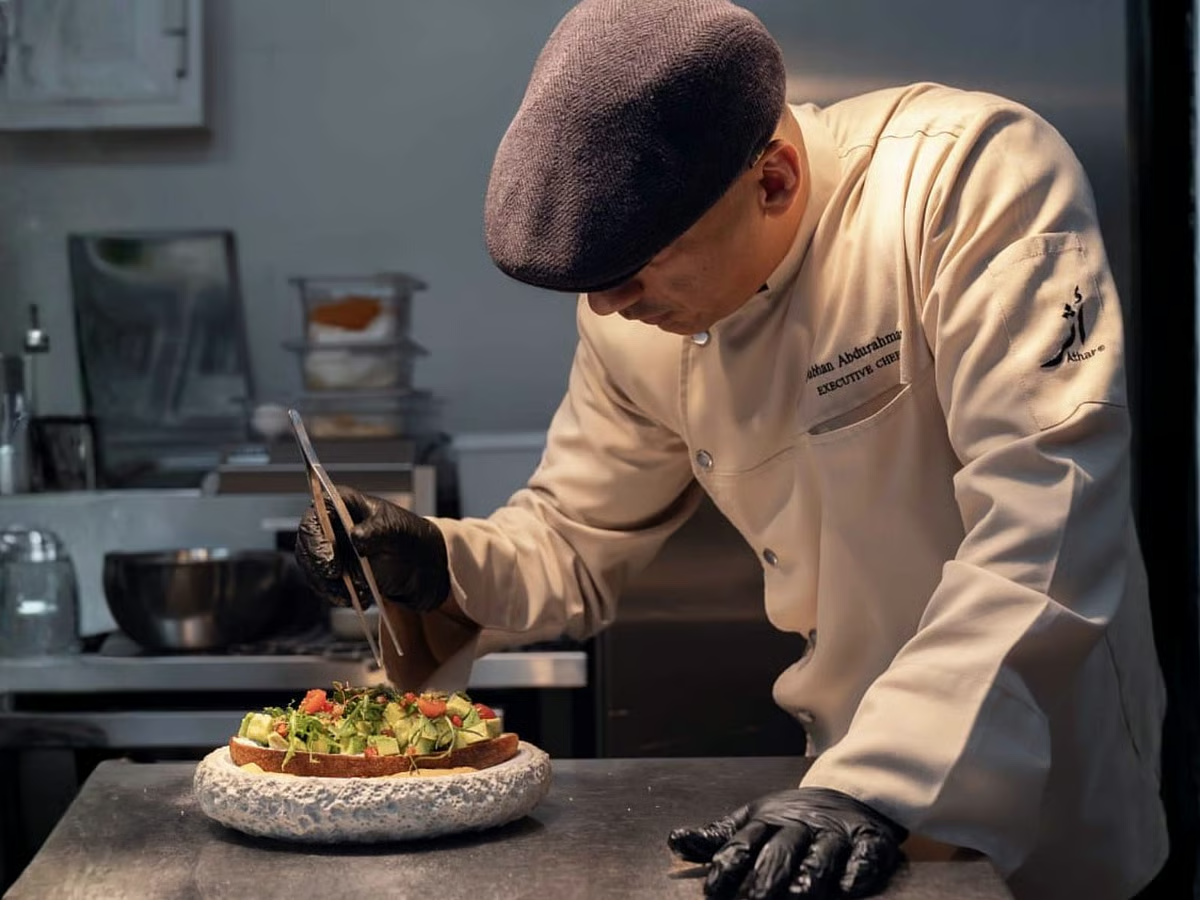
A boxer-turned-chef’s journey to document and elevate the UAE’s culinary heritage is currently unfolding at City Centre Mirdif. The warmth of a mother’s hands as she kneads dough and the aroma of bread baking before sunrise are not simply childhood memories for Chef Nabhan Al Ali, the Executive Chef of ATHAR by Qlab; they are the foundation of his professional philosophy. Its philosophy stems from the meaning of leaving a lasting imprint on every diner with its food, beverages, ambience and heartfelt hospitality rooted in instinctive Emirati generosity.
“My mum always had an answer for everyone,” he says. “I still remember waking up early in the morning and smelling the bread my grandmother was baking. That aroma made me love the kitchen.” This memory has stayed with him for over four decades, shaping a career that bridges the past and future of Emirati gastronomy. Ironically, his success is rooted in early failure. “If you don’t understand the kitchen,” he says, “you don’t understand the business.”
Long before Chef Nabhan mastered the technicalities of a professional kitchen, he understood what it felt like to appreciate a memorable meal. He loved discovering new restaurants and knew what made a dining experience special. In 2009, still in his twenties, he invested in opening his first restaurant. “I couldn’t ask the right questions,” he admits. When the business failed, it taught him a lesson that would define his future: he needed to master the craft himself. Many entrepreneurs would have walked away, but he decided to become the person he wished he had hired.
In 2014, he enrolled at the SCAFA Culinary Institute Dubai, where he met Chilean Chef Francisco, the mentor who introduced him to the discipline, precision and relentless standards of a professional kitchen. For the first time, he wasn’t simply learning recipes; he was learning how kitchens think. More importantly, he learned that running a successful kitchen required as much leadership as culinary skill. “I understand the personality needed to work in the kitchen,” he says. “I’m a boxer. I have that mindset.”
The training transformed him. “I understand the kitchen now,” he says. “I can ask my staff the right questions because I’ve done the work myself.” By 2016, he had opened a healthy food concept built around his passion for fitness and nutrition. Eventually, he sold parts of the business, but for him, that was not the destination. As he travelled across the Emirates, another question occupied his thoughts: where was the authentic local food? He visited hotels and restaurants across the country, but instead, he found international buffets with only the faintest nod to local cuisine.
“There was a gap,” he says simply. “You would find every cuisine, but very little Emirati food.” For a country celebrated for its hospitality, he found remarkably few places serving traditional dishes. Food, to him, carries memory; it tells the story of families gathered around one table and centuries of shared history. The absence represented something much larger than a missing menu; it reflected the quiet erosion of cultural identity. “If people stop cooking the food,” he says quietly, “history disappears with it.”
Rather than accept that reality, he decided to document it. He travelled across the Emirates, from Abu Dhabi to Fujairah, meeting elderly Emirati women who had spent their lives perfecting these recipes. Later, many of those women came to cook with him in his own kitchen. “They weren’t just teaching me recipes,” he says. “They were teaching me our history.” Every conversation became part of a much larger archive, and every recipe revealed something about the country’s heritage.
His ambition was never simply to recreate traditional food; it was to preserve it for the next generation. “I wanted it to be there for the UAE,” he says. “For our children. For the next generation.” The work grew into a personal mission to document Emirati cuisine in its truest form, recording recipes that were once passed down only through oral tradition. He describes the sensory experience of his kitchen, noting the crackle of spices blooming in hot Emirati ghee as a fundamental part of the process.
For centuries, the Emirates stood at the crossroads of global trade. Long before skyscrapers defined Dubai’s skyline, the region was a hub for merchants. “We have richness in our spices,” he explains. “You can see the connection through the Spice Route. We traded, and that influence remains visible today in the layers of flavour found throughout Emirati cooking.” He believes there is something unique about the local palate that deserves global recognition.
“The UAE has so many wonderful restaurants,” he says. “But I don’t think there is another place like ATHAR.” He sees it becoming a destination where visitors experience not only Emirati cooking, but Emirati culture itself. “I think it will become something different,” he says. “In three or four years, I want people to see Emirati cuisine at another level.” Today, at 45, after building businesses and documenting recipes, he finds himself pursuing the same feeling that first drew him into his mother’s kitchen.
The restaurant offers interactive dinners ranging from Dh280 to Dh1,200, designed to immerse guests in the narrative of the region. He remains committed to the idea that food is a vessel for storytelling. By maintaining high standards and authentic methods, he ensures that the legacy of his grandmother and the women he interviewed continues to thrive in a modern, fast-paced city like Dubai.
Ultimately, Chef Nabhan Al Ali’s work at ATHAR is a testament to the power of culinary preservation. By blending his background as an athlete with his newfound expertise as a chef, he has created a space that honors the past while looking firmly toward the future. Whether it is the specific blend of spices or the hospitality extended to every guest, the restaurant stands as a beacon for those seeking the true taste of the Emirates.
“The ingredients stay the same,” he adds.
“Majboos (chicken or meat cooked with aromatic rice),” he says.
“Or Madrooba (a meat and vegetable dish with porridge-like consistency).”
I didn’t ever want to lose like that again.
I am a very competitive sportsman at heart,” explained the former boxer.
When something is wrong, you must address it immediately.
That knowledge would soon prove invaluable.
Every Friday became an opportunity to search for it.
He sat beside them in their kitchens, watching every movement, listening to the stories behind every dish, asking why one spice was added before another, why certain ingredients could never be substituted, why recipes differed from one family to the next.
The dried, fragrant Lumi or lemon remains.
His ambition is not to modernise Emirati food by changing its identity, but by allowing it to stand confidently alongside the world’s great cuisines while remaining unmistakably itself.
For him, evolution should never come at the expense of authenticity.
Meals were placed at the centre of the table, shared between family, neighbours and guests, each dish carrying as much meaning as flavour.
Individual plates have replaced communal platters.
Meals have become quicker, quieter and often more solitary.
That philosophy inspired the restaurant’s sharing plates.
To sit together with family, neighbours and friends, sharing food, conversation and joy.”
Some dishes, however, demand reverence.
It means allowing tradition to evolve without forgetting where it came from.
Inside Chef Shaw Lash’s world of LILA Molino
Laughing Bread head chef on how the community inspires
From machboos to biryani: Behind the scenes at Gerbou
From back-of-house to Michelin buzz: Dubai chef’s rise
Bin Touq leads UAE food mission to India