

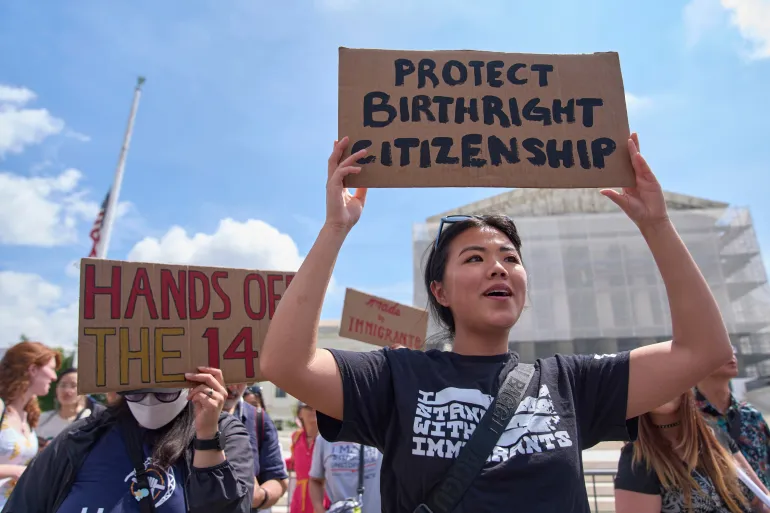
United States President Donald Trump has issued two new executive orders aimed at curtailing birthright citizenship. This move arrives only weeks after the Supreme Court affirmed that the existing practice remains protected under the Constitution.
The latest directives are more limited in scope than the president’s previous attempt to restrict the policy, which currently grants citizenship to nearly all individuals born within American borders. One of the new orders seeks to broaden a specific exception that currently prevents the children of foreign diplomats or invading forces from receiving automatic citizenship.
A second order directs the Secretary of State and the Secretary of Homeland Security to take action against “birth tourism.” This term refers to the practice of foreign nationals traveling to the United States specifically to give birth, thereby securing citizenship for their children.
Speaking from the Oval Office, President Trump criticized the Supreme Court for what he termed a “very unfortunate decision” regarding his earlier efforts to limit birthright eligibility. He claimed the court had “made a joke” out of the concept and noted that his administration is currently “making adjustments” to its strategy.
These actions follow an executive order signed on January 20, 2025—the first day of his second term—which attempted to reinterpret the Fourteenth Amendment. That initial order argued that children born to undocumented immigrants or those on temporary visas were not “subject to the jurisdiction” of the United States and should therefore be ineligible for automatic citizenship.
However, the Supreme Court ruled in June that these attempts to narrow citizenship rights were unlawful. Citing the Constitution’s Citizenship Clause, the majority opinion stated that if Congress had intended to restrict citizenship to the children of those permanently domiciled in the U.S., the language of the clause would have reflected that design.
The administration’s legal argument had posited that the 14th Amendment was originally intended only for children of newly freed slaves and had been misinterpreted since 1868. Chief Justice John Roberts, writing for the majority, rejected this, noting there was “scant evidence for this dramatically revisionist view.” He added that the framers of the amendment extended their promise to “every free-born person in this land,” a commitment the court upheld.
Despite maintaining a conservative supermajority, the Supreme Court saw six justices vote against the administration’s position. This ruling marked a significant legal setback for the president, who has long prioritized hardline immigration policies throughout his political career. The new executive orders are widely expected to face further legal challenges in the coming months.