

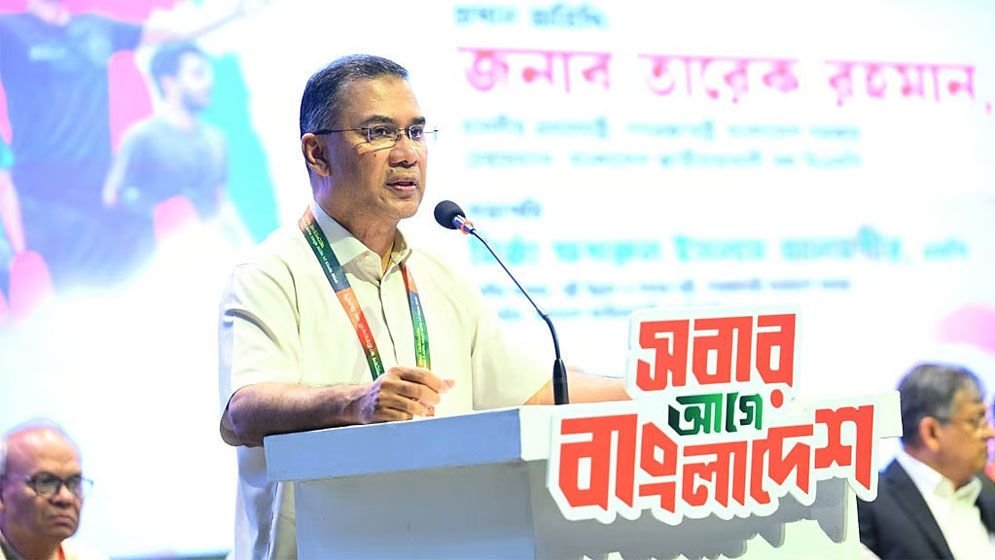
Prime Minister Tarique Rahman stated that the movement that took place in Bangladesh during July and August was entirely a people’s movement. He emphasized that the uprising succeeded because the public demanded change and became fully involved in the process. The Prime Minister made these remarks on Tuesday afternoon, August 4, at the Institution of Engineers, Bangladesh (IEB) in Dhaka, during a discussion titled ’17 Years of Unrelenting Struggle for Democracy and the Bloodstained July Awakening.’
Highlighting that the credit for the July mass uprising belongs to the people, Rahman noted that the success does not belong to any single individual or political party. He recalled that for the past 17 years, the people of the country, along with leaders and activists of the Bangladesh Nationalist Party (BNP) and other pro-democracy political groups, remained on the streets fighting against fascism. He asserted that they never abandoned the public or retreated from the movement.
Addressing the need for national reconstruction, the Prime Minister urged all political parties to focus on moving the country forward. He stressed that after years of debate and struggle, it is now time to rebuild the nation. He advised vigilance against those attempting to conspire and called for patience while the government works to implement its plans, fulfill public expectations, and address the challenges of national development.
Reflecting on reform, Rahman pointed out that the BNP began discussing structural changes long before other political parties. These proposals eventually evolved into the party’s 31-point reform agenda. He highlighted the economic toll of the previous fascist regime, noting that approximately $16 billion was siphoned out of the country annually. He added that the banking, agricultural, and health sectors were systematically destroyed during that period, leaving the current administration to manage a devastated situation.
Regarding the healthcare sector, the Prime Minister expressed concern that kidney dialysis machines have not yet been installed at the sub-district level. He announced plans to install 50-bed dialysis units in district-level medical colleges and 10-bed units in general hospitals within the next three to six months. Furthermore, he committed to establishing 10-bed dialysis facilities at the sub-district level within the next two to three years.
Rahman acknowledged the ongoing electricity and gas shortages, stating that the government is not looking for excuses but is instead working tirelessly to identify and resolve these issues. He explained that the previous regime treated the energy sector as a means to line their own pockets, leading to widespread infrastructure collapse. He noted that the government is currently in talks with various countries, including Myanmar and Malaysia, to secure gas supplies and overcome the energy crisis.
The Prime Minister described the state of the nation upon taking office as having a fragile economy, a broken healthcare system, and a divided administration. He reiterated that the 31-point agenda, which received a mandate from the public during the election, is no longer just a BNP platform but the people’s roadmap for state reconstruction. He emphasized that the primary goal remains the establishment of the political and economic rights of the citizens.
The discussion was chaired by BNP Secretary General and Minister of Local Government Mirza Fakhrul Islam Alamgir. Other speakers included Nagorik Oikya President Mahmudur Rahman Manna, Jatiya Party (Zafar) Chairman Mostafa Jamal Haider, BJP Chairman Andaleeve Rahman Partho, Gono Forum leader Subrata Chowdhury, Revolutionary Workers Party General Secretary Saiful Huq, and various other political figures including Zonayed Saki, Nurul Haque Nur, Fariduzzaman Farhad, Sheikh Rafiqul Islam Bablu, and Aminul Haque. Members of the BNP Standing Committee and other senior leaders were also in attendance.