

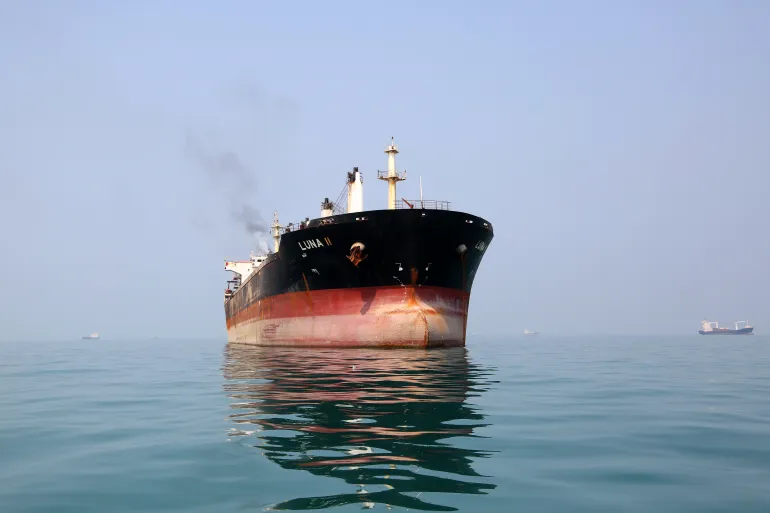
Despite claims from the United States that maritime traffic through the vital Strait of Hormuz is resuming under military escort, global crude prices have experienced a sharp upward surge. The widening rift between Washington’s assurances and market reality underscores a volatile security situation in the Middle East that threatens international energy supply chains.
Crude oil benchmarks surged more than 3 percent on Monday. Brent crude rose $3.21 to reach $107.82 a barrel, while US West Texas Intermediate gained $3.17 to settle at $103.22. The price spikes followed a fresh attack on an Iranian vessel in the Strait of Hormuz alongside a drone strike targeting Saudi Arabia’s vital East-West oil pipeline.
The temporary closure of the Saudi pipeline, which Riyadh relies upon to bypass the Iranian blockade in the Strait of Hormuz by shipping crude to the Red Sea, poses a severe risk. Officials in Saudi Arabia stated the drone attack originated from Iraq, warning that up to four percent of the global oil supply could be threatened if the pipeline remains offline indefinitely.
Energy markets faced further disruption following additional drone and missile strikes launched by Yemen’s Houthi group into southern Saudi Arabia. On Tuesday, strikes hit civilian and economic locations across Abha, Khamis Mushait, Jizan, and Najran, resulting in 73 injuries, including women and children. The assault marks a major escalation in the Yemeni conflict, which re-ignited in July after nearly four years of relative quiet under a United Nations truce.
Disagreements over control of the Strait of Hormuz remain at the center of the market panic. US Energy Secretary Chris Wright stated on Sunday that flows through the waterway averaged 10 million barrels per day over the past week. He noted that traffic was back to two-thirds or north of two-thirds of previous levels, adding through Bloomberg News that while world oil markets are tighter than preferred, they are not overly tight.
President Donald Trump echoed those assertions, declaring that American forces maintain total control of the waterway and are successfully escorting tankers carrying millions of barrels. The Strait of Hormuz normally handles approximately one-fifth of the world’s daily petroleum and natural gas supplies.
Tehran has flatly contradicted the American claims, insisting that it retains control over passage through the strait and cautioning commercial vessels against taking unauthorized routes. Iranian authorities recently designated a restricted maritime zone around the passage. Meanwhile, Iran’s Islamic Revolutionary Guard Corps reported on Monday that it intercepted and destroyed an advanced American MQ-1 drone flying over the channel.
Independent tracking data shows commercial transit remains drastically depressed compared to historical norms. Pre-conflict volumes routinely exceeded 100 ships and 20 million barrels per day prior to the outbreak of hostilties involving the US, Israel, and Iran in February. Recent vessel-tracking figures indicate daily transits dropped to single digits over the weekend, remaining far below the recent 10-day average of 14 ships per day, with only four vessels exiting the Gulf and 10 entering. Analysts note that some tankers transit with Automatic Identification System transponders deactivated, leaving them off official logs.
Market analysts caution that US assurances are failing to calm energy traders because physical threats to shipping remain active. Chris Beauchamp, chief market analyst at IG Group, emphasized that despite official US statements, the strait is not under American control and oil is not flowing freely. He noted that near-month futures are trading at a premium over spot prices, reflecting expectations of sustained market strain.
Escalating maritime costs are also driving up energy valuations. Abdul Khalique, head of the Liverpool John Moores University Maritime Centre, noted that the Houthis’ expanding presence near the Bab al-Mandeb strait—a crucial passage connecting Asian and European trade—has severely disrupted global shipping. War risk insurance premiums for Hormuz transits have jumped from 0.25 percent of hull value prior to the conflict to between 3 and 10 percent. For a standard $100 million tanker, a single journey now incurs an insurance premium between $3 million and $10 million before freight and cargo coverage are calculated.
Market fundamentals offer little relief for rising fuel prices. Christopher Haines, Global Head of Oil at Energy Aspects, pointed out that global crude reserves are dangerously depleted. With scheduled releases from the US Strategic Petroleum Reserve concluded and seasonal winter demand rising in the Northern Hemisphere, refiners must operate at high capacity. Consequently, prices must rise to force demand destruction.
Diplomatic resolutions appear out of reach for the immediate future. Energy Secretary Wright noted that counting on a consensual agreement with Iran today is certainly not a good bet. Furthermore, a planned summit in Oman between Iranian officials and Gulf nations was postponed by Saudi Arabia following recent developments in Yemen, leaving energy markets braced for further disruptions. The report also notes that what are the US, Iran and others claiming about the Strait of Hormuz. The report also notes that “The US Strategic Petroleum Reserve (SPR) has little to give with announced releases having ended… while China will not be able to reduce their buying as they did in the summer due to higher seasonal demand in the winter. The report also notes that “We believe oil prices can continue to rise, as without the buffers we have had over recent months, prices will have to increase to curb demand.”. The report also notes that “Crude buying has been robust as refiners have to run harder to produce the fuels the northern hemisphere needs for heating. The report also notes that “With no one in a hurry to talk, it seems that oil prices will continue to rise, and a return to March’s highs seems to be a matter of when, not if,” Beauchamp said. The report also notes that “Having already taken the port of Mocha and the islands of Hanish and Zuqar earlier in the week, Iran-aligned Houthi forces seized the strategically vital Perim (Mayyun) Island and the mainland town of Dhubab, giving them effective control of Yemen’s entire Red Sea coastline.”. The report also notes that “The US may hold substantial military control over the battlespace, but it has not restored the conditions needed for a resumption of normal commercial shipping, and that gap is precisely why oil prices continue to climb even as Washington declares victory.”.