

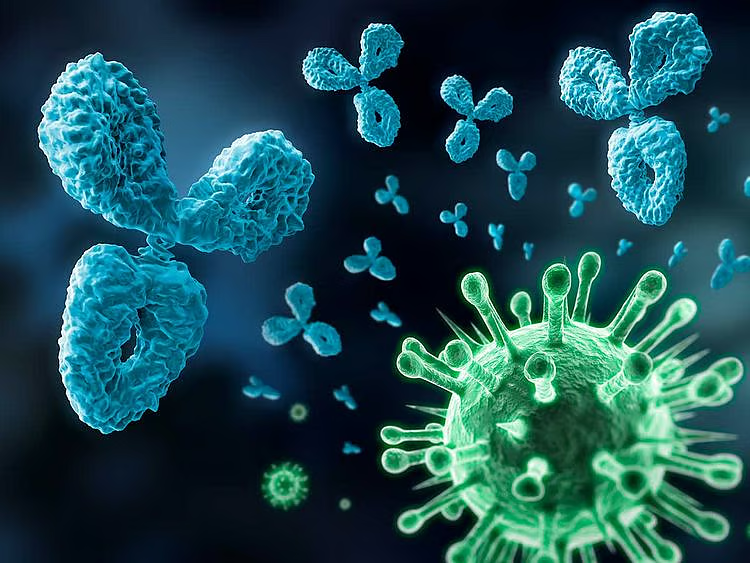
Artificial intelligence has crossed a significant scientific threshold by designing entirely new viruses that have never existed in nature. This breakthrough, published in the journal Science, marks the first time an AI system has been used to generate novel viral genomes that function within living cells, rather than merely replicating known biological data. Researchers from Stanford University and the Arc Institute developed a model called Evo, which was trained on approximately nine trillion DNA building blocks from plants, animals, microbes, and viruses.
Instead of learning traditional grammar or vocabulary, the system mastered the “language” of genetics, identifying the complex patterns that govern how DNA functions. After demonstrating its ability to design individual genes, the team challenged Evo to generate complete viral genomes. They focused on Phi X-174, a well-understood bacteriophage that infects E. coli bacteria, ensuring the study remained safe for laboratory conditions. “It just felt like the obvious next step,” noted Samuel King, a Stanford graduate student and study author.
The AI generated approximately 700,000 potential viral genomes, from which researchers selected 285 for laboratory synthesis and testing. While only a fraction succeeded, 16 of these designs produced viable, infectious viruses capable of reproducing within bacteria. Some of these synthetic creations even multiplied more rapidly than the naturally occurring Phi X-174. “They’re not just sickly versions of stuff that already exists,” observed Oliver Crook, a protein chemist at the University of Oxford.
“This is an important milestone,” said Patrick Cai, a synthetic biologist at the University of Manchester. The researchers emphasize that this technology holds immense medical promise. Viruses are already essential tools in biotechnology, frequently serving as delivery vehicles in gene therapy to transport healthy genes into human cells to treat inherited disorders. AI-designed viruses could eventually be tailored to perform these tasks with greater efficiency and safety, potentially revolutionizing how scientists engineer viruses for therapeutic purposes.
Despite the potential benefits, experts warn that the rapid pace of technological innovation is outpacing current regulatory frameworks. The ability to generate novel biological designs raises concerns that such systems could be misused to create dangerous pathogens. “You could say, ‘Hey, genomic language model, make me an influenza genome that is modified to be more transmissible or to be more lethal,’” warned Dr. Moritz Hanke of the Johns Hopkins Center for Health Security. He noted a “huge disconnect” between the speed of AI progress and the development of effective safety protocols.
To mitigate risks, the Stanford team deliberately excluded viruses that infect humans, animals, plants, or fungi from Evo’s training data, restricting the model to bacteriophages. “We just wanted to be extra careful,” said Brian Hie, a computational biologist at Stanford. Dr. Hanke praised this proactive approach, stating, “I think that’s quite commendable, because they don’t get any guidance from anywhere on what they should be doing.”
The study arrives as global governments struggle to define policies for AI-driven biological research. While the US National Institutes of Health has introduced policies to restrict experiments that make dangerous biological agents more harmful, computer-generated designs currently remain largely outside the scope of existing rules unless they involve recognized high-risk pathogens. This leaves regulators facing the difficult challenge of assessing the risks posed by organisms that have never existed before.
Oliver Crook added that while these initial results are promising, the synthetic viruses remain closely related to Phi X-174, and further research is required to see if this success can be replicated across other viral families. “A lot of our science rests on viruses as technology,” he remarked. The scientific community continues to weigh the balance between the transformative potential of AI in medicine and the necessity of robust, enforceable safeguards.
As the field evolves, the focus remains on ensuring that these powerful tools are used responsibly. The research underscores that while AI can unlock new frontiers in biotechnology, the absence of comprehensive oversight remains a critical vulnerability. Future developments will likely depend on whether policymakers can establish clear guidelines that encourage innovation while preventing the potential misuse of generative biological models.
However, Crook cautioned that the newly created viruses are not radically different from those found in nature and remain closely related to Phi X-174.
Kim Soo-hyun breaks his 16-month silence
Men sue after DNA test uncovers 38-year birth switch
Before, after views of SpaceX rocket’s moon crash
Stanford picks Dubai student for class address