

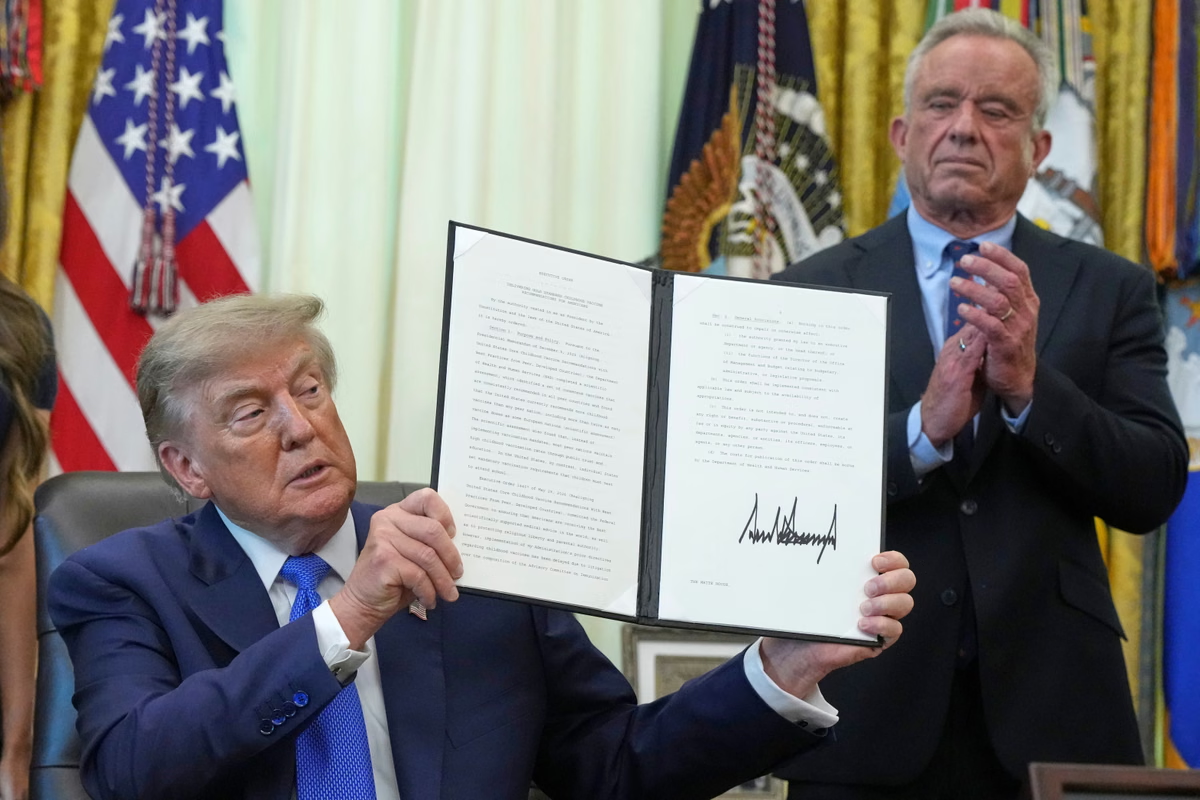
Donald Trump has issued an executive order aimed at overhauling the national childhood vaccination schedule, a move that seeks to bypass the established authority of the US Centers for Disease Control and Prevention (CDC). The directive attempts to reinforce changes to CDC recommendations that were previously blocked by a federal judge, asserting influence over an agency that traditionally holds the mandate for public health guidance.
A central component of the order is the requirement to split the measles, mumps, and rubella (MMR) vaccine into three distinct injections. Furthermore, the administration is recommending that all childhood immunizations be administered during separate medical appointments. Trump defended this approach, stating, “Together, there could be a possibility they’re quite lethal,” while claiming that separating shots would prevent adverse outcomes he described as an “epidemic.”
The order also mandates that six specific vaccines—hepatitis A, hepatitis B, rotavirus, meningococcal disease, influenza, and Covid-19—be moved to a category of “shared clinical decision-making.” This shift requires healthcare providers to weigh risks and benefits for each patient, despite extensive clinical evidence confirming the safety and efficacy of these immunizations.
Implementing the separation of the MMR vaccine faces significant practical hurdles, as there are currently no separately licensed vaccines for these diseases in the United States. Developing and licensing such products would require a multi-year regulatory process. Additionally, the mandate for individual medical visits for every childhood shot is expected to impose substantial logistical and financial burdens on both families and pediatric providers.
Throughout the signing ceremony, both President Trump and Health Secretary Robert F. Kennedy Jr. repeatedly linked vaccination to autism, a claim that has been debunked by numerous scientific studies. Kennedy asserted that an “environmental exposure” in the mid-1990s fundamentally altered children’s health, while Trump claimed to have seen proof that combined vaccinations cause harm, describing the volume of a standard dose as being like a “bottle of soda” poured into a child.
The administration’s plan includes directing the US attorney general to challenge state laws that conflict with these new federal directives. However, because the US lacks federal vaccination mandates—with school requirements determined at the state and local levels—the legal reach of the order remains limited. Executive orders function as guidance for federal agencies rather than binding legislation passed by Congress.
Experts have expressed skepticism regarding the order’s practical impact. Dorit Reiss, a vaccine policy specialist at UC Law San Francisco, noted that the order should have “no direct operational effects,” particularly since 29 states and the District of Columbia have already decoupled their requirements from CDC schedules, and insurance coverage remains unaffected.
Despite the lack of legal force, Reiss warned that the president’s influence could heighten political pressure on states to revise their school immunization requirements. The move has already drawn sharp criticism from lawmakers, including Senator Bill Cassidy of Louisiana, who is a physician.
In a public response, Cassidy condemned the order, stating, “I’m a doctor. This executive order is wrong. The President does not have the expertise to make these changes.” He emphasized that vaccines are safe and effective, and that breaking them into separate visits would likely increase hesitancy and decrease protection for children. “Parents should listen to their child’s pediatrician about vaccines rather than listening to an inaccurate executive order,” Cassidy added.