

Hollywood’s ongoing fascination with historical epics often clashes with audience indifference. Recent years have seen a string of underperforming medieval-themed projects, from Timothée Chalamet’s The King and Chris Pine’s Outlaw King to the financial disappointment of Ridley Scott’s The Last Duel, which recouped only a third of its $100 million budget. Even the Saudi-backed seventh-century drama Desert Warrior, featuring Anthony Mackie and Ben Kingsley, struggled to gain traction. Meanwhile, industry discourse remains fixated on the perceived failures of such films, with Ridley Scott recently attributing the poor performance of Gladiator II to Paul Mescal not being “masculine enough”—a critique that relies on a narrow and questionable definition of the term.
On paper, The Uprising appeared poised for success, pairing the acclaimed director of the Bourne trilogy, Paul Greengrass, with the nuanced performance of Andrew Garfield. Set against the backdrop of the 1381 Peasants’ Revolt, the film aims to mirror modern anxieties regarding authoritarianism. However, the final product is a disjointed, muddy slog that lacks emotional resonance, feeling more like a repetitive History Channel documentary than a compelling cinematic narrative.
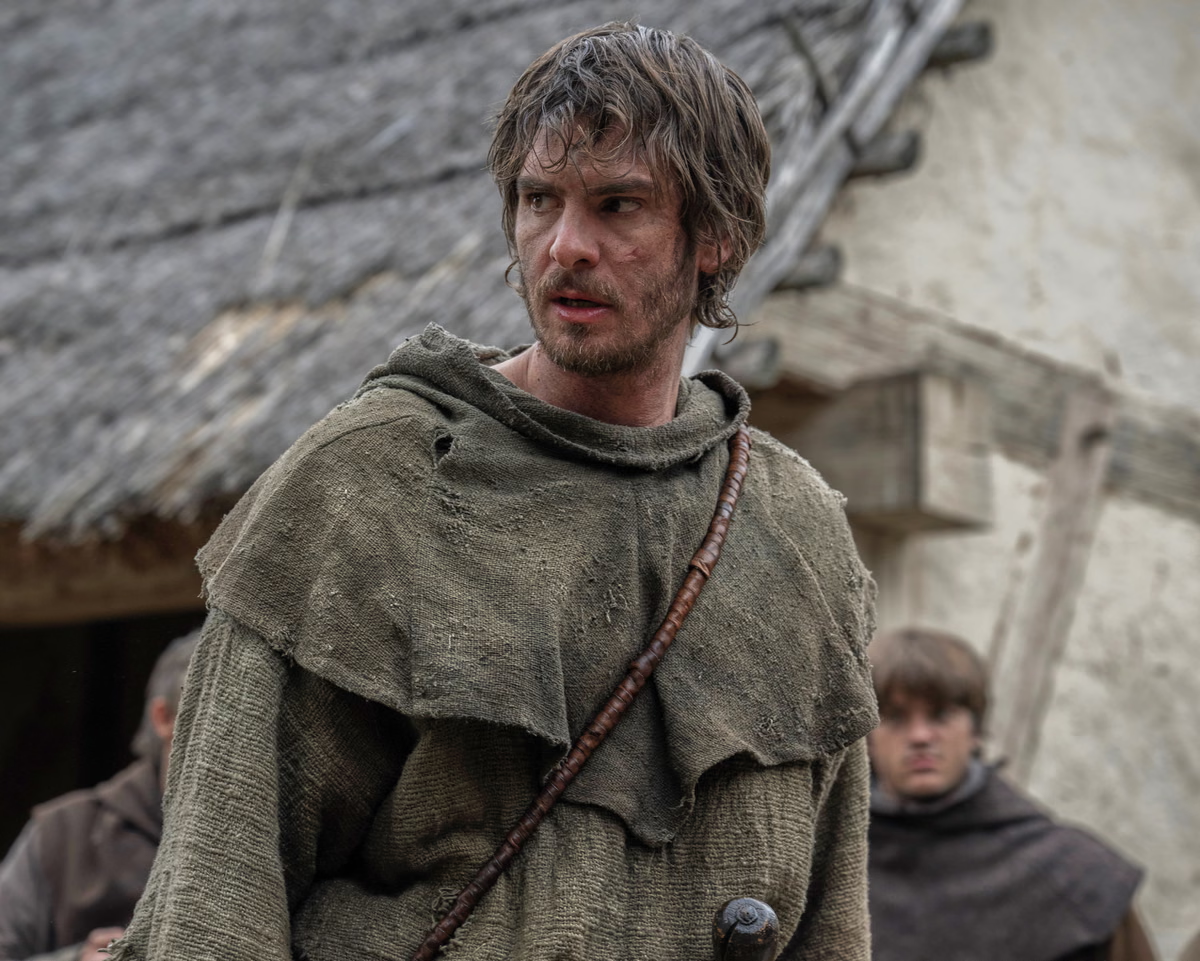
Greengrass depicts late 14th-century England as a miserable, sludge-filled landscape where the populace suffers under a despotic king and crushing taxes. Garfield stars as a character known only as Ploughman, a man mourning his wife and children after they succumbed to the plague. Driven by grief and systemic injustice, he eventually snaps, declaring, “We’ve given you enough,” before sparking a riot. His character is intended to serve as an everyman figure, yet he lacks the necessary magnetism to anchor the film, often feeling indistinguishable from the background.
The narrative gains some momentum with the introduction of historical figures Wat Tyler and the priest John Ball, played by Cosmo Jarvis and Jamie Bell, respectively. Unlike Garfield, these actors possess a grounded, period-appropriate presence. Alongside a character named Alyce, portrayed by Thomasin McKenzie, they lead a march on London to confront the king and advocate for the egalitarian principles found in the Domesday Book. The journey takes them through Kent, from Maidstone to Canterbury Cathedral, and eventually to Blackheath.
While Greengrass occasionally captures striking aerial shots of the Thames, his signature handheld camera style feels exhausted here, resulting in seasick-inducing fight sequences. The film is bolstered by brief, sharp performances from Katherine Waterston as the king’s mother, and Tom Hollander and Stephen Dillane as members of the royal counsel. A singular, gruesome moment in the third act provides a rare jolt of intensity, though it is overshadowed by tedious scenes of Ploughman polishing his scythe or long-winded debates at Windsor Castle.
Ultimately, Garfield’s efforts to elevate the material are hindered by a script that fails to effectively draw parallels to contemporary political life. The film moves at a frantic pace, denying the audience space to connect with the plight of the downtrodden. In a desperate bid to generate interest, distributor Focus Features briefly rebranded the film as The Uprising: The Rise of Robin Hood, despite the historical inaccuracy of linking the Peasants’ Revolt to the legendary outlaw. The film makes no actual mention of Robin Hood, serving as a hollow marketing tactic for a project that remains largely unengaging.
The Uprising is scheduled for release in the United States on 11 September, in the United Kingdom on 9 October, and in Australia on 22 October. The report also notes that late 14th-century England seems like an utterly wretched place, not only because of the sludge-grey sky, scratchy brown sacks that everyone wears and the fact that no one seems to have had a wa, through Greengrass’s lens. The report also notes that “We’ve given you enough,” he cries, as the townspeople’s collective rage boils over into a riot. The report also notes that h ollywood loves giving young actors their own historical epic as much as audiences seem to dislike watching them. The report also notes that last week, it was reported that Scott blamed the failure of Gladiator II on Paul Mescal not being “masculine enough” in a logical leap which only makes sense if your barometer for masculinity is a man who throws hotel phones and yells at producers in storage closets. The report also notes that on paper, The Uprising should be different: it’s a historical epic from a blue-chip director (the Bourne trilogy’s Paul Greengrass ), a nuanced, introspective leading man (Andrew Garfield ) and a milieu that uncomfortably chimes with the western world’s backslide into repressive authoritarianism (The Peasants’ Revolt of 1381). The report also notes that one day he swipes clean the table of the taxman, when asked for proof of his family’s death.