

A Syrian court sentenced ousted leader Bashar Al Assad to death on Tuesday following a trial in absentia, convicting him of serious crimes including killings, torture, and arbitrary arrest during the country’s nearly 14-year war. This verdict marks the first Syrian conviction against Assad, who was ousted in a rebel offensive in December 2024 that ended decades of his family’s iron-fisted rule and the brutal conflict that claimed the lives of hundreds of thousands of Syrians.
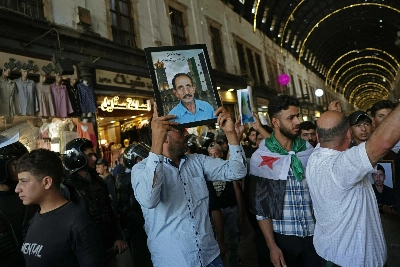
As news of the sentences spread, Syrians gathered around the court in Damascus, chanting, clapping, and waving the national flag. Assad fled the capital as rebel fighters closed in nearly two years ago and is currently residing in Russia, where he and his family were granted asylum on humanitarian grounds.
During the proceedings, the judge handed down a death sentence to the former president for the “premeditated and intentional murder of more than one person and of children, torture, arbitrary arrest and crimes against humanity.” The court also issued the same sentence in absentia to Assad’s brother, Maher, who headed the fearsome Fourth Armoured Division. This unit was responsible for violent crackdowns on protests, recapturing Syrian territory on behalf of the regime, and was accused of spearheading the production and trade of drugs to enrich the Assad family.
A death sentence was also handed down to Atef Najib, an Assad-era security official in the southern province of Deraa, where the first protests against the regime erupted in 2011. Najib, a cousin of the Assads, was detained by Syrian security forces in early 2025 and remains the only accused individual to be tried in person. In Deraa, crowds gathered to celebrate the ruling, carrying pictures of those arrested or killed during the war, including Hamza al-Khatib, a 13-year-old boy who activists reported was arrested, tortured, and killed by security forces.
Noha al-Masri, a prosecutor present at Tuesday’s sentencing, lost her own brother in a 2011 crackdown on a Deraa protest. “The ruling that came, as we expected, was as big as the sacrifices that Syrians gave for 15 years, as big as the suffering of the families and relatives of the martyrs,” Masri told Reuters. The sentencing concludes a nearly four-month trial process, which Syria’s new Islamist-led authorities have billed as a sign that the country is prioritizing transitional justice to move away from the Assad era.
However, legal experts have raised concerns that the death sentence could complicate future accountability efforts. Some observers noted that the ruling would diminish any chance of Assad and his fellow defendants being repatriated to face justice in their home country. “There is a huge problem, which is that no one will hand over a criminal to a country that issues a death sentence. This will cut off the road to Assad, and many other criminals, being handed over to Syria,” said Anwar al-Bunni, head of the Syrian Centre for Legal Studies and Research. He added, “This is performative justice, not transitional justice.”
Assad, born in 1965, assumed the presidency in 2000 following the death of his father, Hafez. He maintained his family’s rule and the dominance of their Alawite sect in the Sunni Muslim-majority country, while positioning Syria as a strategic ally of Russia and Iran and a staunch opponent of Israel and the United States.
Shaped in its early years by the Iraq war and Syria’s military presence in Lebanon, Assad’s rule was defined by the conflict that spiraled out of the 2011 Arab Spring. When Syrians took to the streets to demand democracy, they were met with deadly force by his security apparatus. Branded an “animal” in 2018 by U.S. President Donald Trump for the alleged use of chemical weapons—an accusation he denied—Assad outlasted many foreign leaders who believed his demise was imminent in the early days of the conflict.
The tide finally turned in 2024, when rebels led by now-President Ahmed al-Sharaa swept across Syria in a lightning offensive that lasted less than two weeks, effectively ending the Assad family’s long-standing grip on power. Beyond this domestic conviction, Assad already faces an active international arrest warrant in France related to the 2012 bombing of a press center in Homs.