

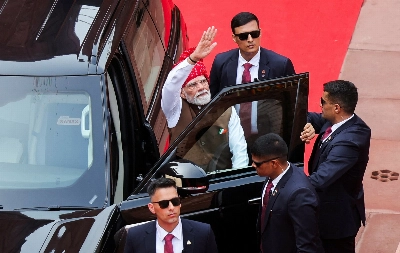
On the occasion of India’s 80th Independence Day, Prime Minister Narendra Modi delivered a 76-minute address from the ramparts of the Red Fort. Marking his 13th time hoisting the national flag, the Prime Minister led a ceremony that included the national anthem and a 21-gun salute. A historic milestone occurred as the full rendition of Vande Mataram was performed at the site for the first time since independence, a moment the Prime Minister described as deeply resonant.
A central theme of the address was the empowerment of the nation’s youth. PM Modi announced a government initiative to provide artificial intelligence skills training to 10 million young people over the coming year, intended to position them as leaders in the global AI landscape. Additionally, he pledged free online coaching for competitive examinations to support students from low- and middle-income families.
The Prime Minister issued a stern warning against what he termed “Dimagi Naxalism,” referring to ideological forces he claims are attempting to mislead the youth and incite anarchy. While noting that armed Naxalism has significantly declined, he urged the public to remain vigilant against those seeking to create internal discord.
Looking toward the future, PM Modi reaffirmed his confidence that India will achieve developed nation status by 2047. He characterized this “big dream” as a necessary evolution of the country’s ambition, arguing that small goals are no longer sufficient. He emphasized that by combining steadfast resolve with national strength, India can overcome any obstacle and inspire the global community.
Reflecting on the progress made over the last 12 years, the Prime Minister highlighted India’s transition from the “Fragile Five” to one of the world’s fastest-growing economies. He cited significant growth metrics: defense production has risen fourfold, electronics manufacturing sevenfold, mobile phone production 33-fold, and modern railway coach output 21-fold. Furthermore, the digital economy has seen a 100-fold surge in transactions, while internet usage has quadrupled.
Social welfare improvements were also a focal point. The government has accelerated the delivery of basic services, increasing the rate of tap-water connections by 15 times, gas connections by six times, and housing for the underprivileged by three times compared to previous periods. These achievements, he noted, were supported by governance reforms that eliminated thousands of compliance requirements and repealed hundreds of archaic laws.
The Prime Minister encouraged citizens to embrace “Make in India,” “Swadeshi,” and “Vocal for Local” initiatives to bolster domestic self-reliance. He also addressed the recent floods affecting parts of the country, calling for national unity and collective effort in the face of such challenges.
Following his speech, PM Modi engaged in a spontaneous interaction with the crowd, breaking protocol to greet schoolchildren, NCC cadets, and ‘My Bharat’ volunteers. In a widely noted moment, he helped a young girl retrieve her cap after she bent to touch his feet, an act that drew praise from the audience. By walking toward the enclosures to shake hands and speak with the youth, the Prime Minister underscored the focus on the next generation that defined his address.
A major highlight of the speech was a series of announcements focused on the country’s youth.
He also announced free online coaching for various competitive examinations for youth from poor and middle-class families, aiming to open doors of opportunity and strengthen their path to success.
He called this vision of Viksit Bharat a “big dream” that expands the nation’s thinking and broadens its horizons.
A nation becomes great when it moves forward driven by its dreams, firm resolve and inherent strength.
When resolve is steadfast, the capacity to carve a path even amid difficulties and disasters naturally emerges.
He urged citizens to work collectively towards this goal, noting that when the world’s most populous country takes such a resolution, the world is compelled to view it with a different perspective.
Reflecting on the past 12 years, the Prime Minister outlined India’s remarkable economic and social transformation.
Production by Khadi and village industries had grown almost fivefold.
In the digital sphere, the number of internet users had nearly quadrupled, patent grants had risen fourfold, and digital transactions had surged 100-fold.
He stressed that the whole country is moving forward with a new resolve.
By dreaming big and working with determination, he said, India would not only realise the vision of a developed nation by 2047 but also inspire the world with its courage and achievements.
The address blended pride in past accomplishments with a clear forward-looking agenda, placing youth empowerment, technological readiness, economic self-reliance and national unity at the heart of India’s next phase of growth.
Her cap slipped off and fell to the ground.
Without hesitation, PM Modi bent down, picked up the cap and gently placed it back on her head, drawing smiles and applause from those around.
The simple act of care and humility left the children visibly overjoyed.
He shook hands, exchanged brief words and offered warm greetings, giving the excited youngsters a close-up moment with the nation’s leader.
Many later shared their excitement with the media, describing the experience as thrilling and unforgettable.