

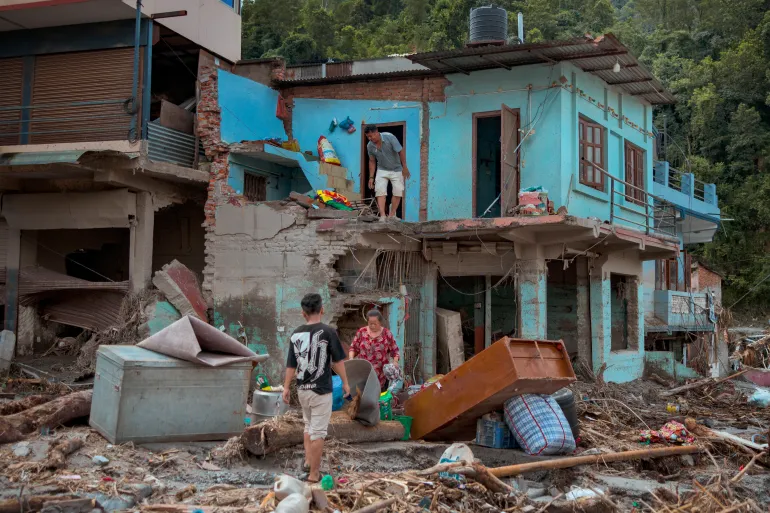
The death toll from the devastating floods near the border between Nepal and China has climbed to nearly 800, with thousands of individuals still missing in the wake of Wednesday’s disaster. The catastrophe was triggered by a massive glacier collapse high in the Himalayas, which unleashed torrents of water and landslides that buried entire villages and infrastructure.
Authorities across Nepal and the Tibet region of China have confirmed that the total number of missing persons exceeds 3,000. The impact of the disaster has been widespread, with some bodies discovered as far away as neighbouring India. In Nepal, the Independent Power Producers’ Association reported that as of Sunday morning, approximately 933 people remain unaccounted for, specifically from 11 hydropower project sites and tunnels located in the heavily impacted Rasuwa and Nuwakot districts.
Rescue operations have faced immense difficulties due to destroyed roads and bridges. At the 216-megawatt Upper Trishuli-1 hydropower project, Nepali soldiers have been documented wading through thick mud to reach workers trapped in tunnels. While the army has successfully rescued 254 individuals from that site, efforts at other locations, such as the 22MW Chilime Hydropower project, have been stalled. Baburaj Maharjan, executive director of the Chilime Hydropower Company, stated that they have been unable to conduct rescues because the tunnels are completely filled with mud, making entry impossible.
To address the crisis, the Nepalese government has prioritized clearing tunnel entrances. A joint task force of 82 personnel, including 62 from the Nepali Army and 20 from the Armed Police Force and local police, has been working continuously to remove debris. Overall, Nepal’s Foreign Secretary Amrit Bahadur Rai announced that 19,000 security personnel and 16 helicopters have been mobilized for search and rescue missions. Additionally, an 11-member team of medical and tunnel-rescue specialists from India arrived on Saturday to assist with aerial assessments.
The situation remains precarious due to the formation of a barrier lake caused by debris accumulation. On Friday, rising water levels forced a temporary suspension of search efforts amid fears of a secondary flood. Chinese authorities, who are monitoring the lake near the port of Gyirong using satellites, radars, and drones, have indicated that while the risk has diminished, it has not been entirely eliminated. They have assured that if conditions deteriorate, they can provide approximately 30 minutes of warning to rescue teams operating downstream.
The human toll is complex, involving citizens from Nepal, India, South Korea, and China. In Nepal, 2,498 people remain missing, including 589 foreign nationals, 127 Nepalese citizens traveling with them, and dozens of military and police personnel. Meanwhile, in Tibet, Chinese officials reported 16 deaths in Gyirong County and noted that 261 foreign nationals from 23 countries are missing, including 104 Nepalese and 49 Indian citizens.
The logistical burden of identifying victims has become a significant challenge. According to the Kathmandu Post, bodies are being recovered far downstream, and local morgues are reaching capacity. Unidentified remains are currently being distributed across 21 hospitals in various districts for preservation and formal identification. Nepal initially declined international assistance to avoid the chaos of uncoordinated teams, but the urgency of the situation has since led to a shift in policy.
Financial and material support has begun to arrive from the international community. China has mobilized 2,100 rescue workers and allocated at least 220 million yuan ($32.7m) for relief efforts. Other significant contributions include $3.6m each from the United States and Canada, $6.8m from the United Kingdom, and $2.5m in emergency funding from the United Nations. The European Union has pledged $2.3m, while the International Federation of Red Cross and Red Crescent Societies has launched an emergency appeal for $31m, having already allocated $1m to the cause. The report also notes that rescue efforts are under way to locate more than 900 missing workers at hydropower projects in central Nepal. The report also notes that rescue operations resumed after the lake threat was deemed manageable. The report also notes that katrina Yu, reporting from Beijing, said that Chinese authorities say the risk seems to have been reduced, but it has not disappeared. The report also notes that radars, and drones,” she said, adding that “authorities are confident that if the situation around the barrier lake should deteriorate, they will be able to give notice of about 30 minutes to rescuers below”, they are closely monitoring using satellites. The report also notes that “After complaints emerged that people were trapped inside the tunnel, the government prioritised the deployment of a rescue team and has been advancing the work to clear the entrance by removing debris and rubble,” Nepal’s prime minister’s office said late on Saturday. The report also notes that however, with adverse weather conditions persisting in the area, the rescue efforts have become quite challenging,” the statement added. The report also notes that such as the 22MW Chilime Hydropower project in Rasuwa district, 133 km (82 miles) north of the capital, Kathmandu, but rescue efforts have also proved challenging at other hydropower sites.