

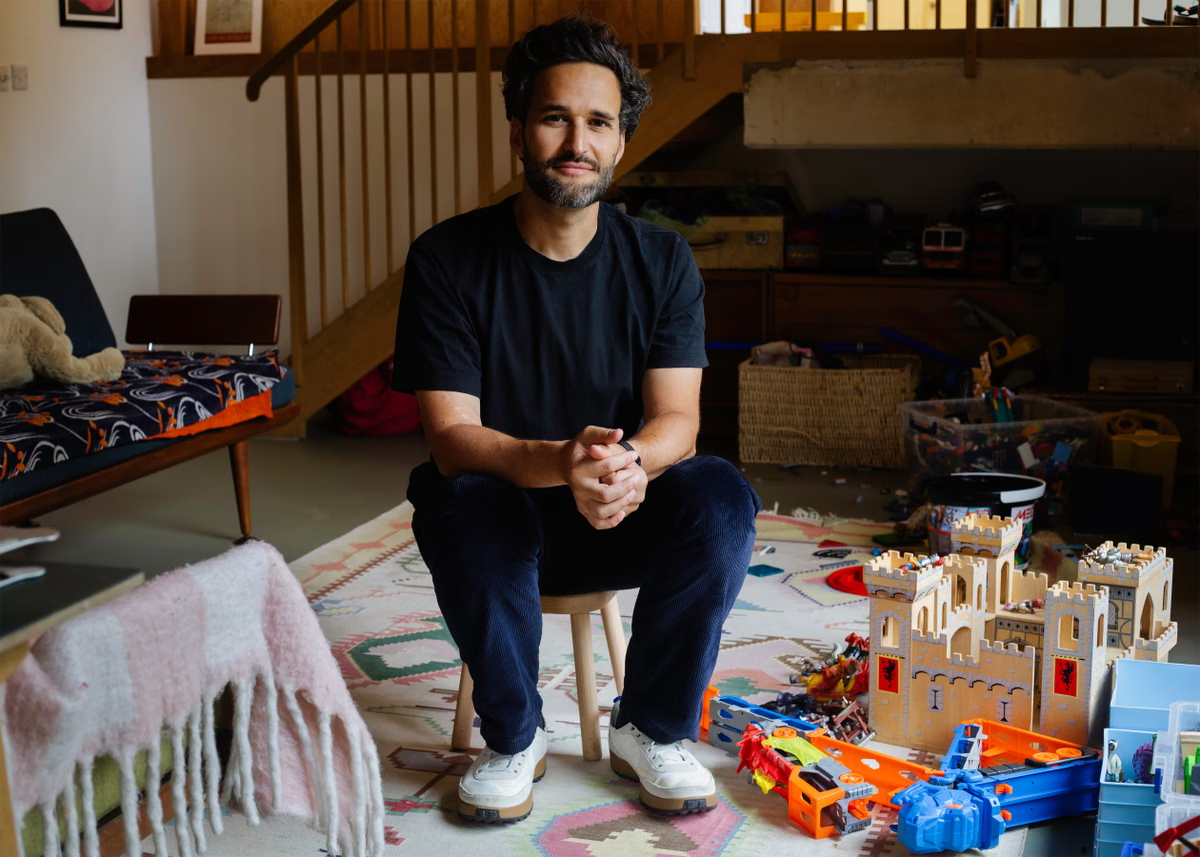
For the past 15 years, I have analyzed the profound impact of artificial intelligence on labor markets and societal structures. However, being a father to three children—aged eight, five, and two—has transformed these abstract professional concerns into immediate, personal realities. The rapid evolution of AI is not just a workplace disruption; it is fundamentally reshaping how our children learn, play, and perceive the world.
My own realization of this shift began with a simple creative experiment. Years ago, my father and I had discussed writing a story titled “The Day Nobody Went to Disneyland,” but we never found the time. Recently, while dining with my children, the idea resurfaced. I prompted an AI to write the story, and it produced a complete narrative in seconds. When I shared it with my oldest child, she was captivated, though I noticed minor flaws—a few nonsensical lines and misplaced Americanisms like “sneakers” and “cinnamon buns.” Despite these imperfections, the ease with which the machine generated a compelling story was a striking demonstration of its power.
This experience highlighted the dual nature of AI. It is a tool of immense capability, yet it introduces new vulnerabilities. My wife and I recently encountered this ambiguity while traveling to visit her parents in Suffolk. The journey along the A12 with three children in a confined space is often a volatile situation, but we found a rare respite in a podcast titledHistory’s Not Boring. The series featured 15-minute segments on diverse topics narrated by two children. We spent much of the drive speculating about these young hosts, only to discover later that they were not human at all, but AI-generated voices. The quality was remarkable, yet it left us questioning the implications of such seamless synthetic content.
The central dilemma for parents and educators today is how to respond to this technological wave. Many instinctively lean toward prohibition—banning devices, punishing usage, or viewing AI as a form of cheating. However, this reactionary approach is both misguided and unimaginative. If AI makes certain tasks “too easy,” the burden shifts to adults to ensure that education remains challenging and rigorous. We must ask ourselves at what point our failure to push children to think critically becomes a disservice to their development.
The traditional concept of “future-proofing” education has proven to be a flawed strategy. In 2013, then-prime minister David Cameron, supported by education secretary Michael Gove, pushed to make England the first nation to mandate coding in schools, believing it would equip children with essential 21st-century skills. Yet, by January 2026, Anthropic revealed that 90% of the code for its Claude Code assistant was written by AI. This highlights the danger of betting on specific technical skills that AI can eventually perform better than humans. The frustration felt by young professionals—who spent years and significant money training for careers now being disrupted—is a warning that we cannot simply predict which skills will remain “safe” from automation.
We are currently in a period of transition where the best ideas of the 20th century were products of human intellect, while the 21st century increasingly relies on AI-driven insights. A clear example occurred in late 2024, when DeepMind’s AlphaFold2 won the Nobel prize in chemistry for solving the protein folding problem, a monumental biological challenge. This shift suggests that we must return to basics. OECD data shows a global decline in literacy and numeracy since 2009. We must prioritize these foundational skills, not because AI cannot do them, but because they are the bedrock of human cognition. Furthermore, AI is prone to hallucinations and errors, making it essential for humans to possess the knowledge required to verify and challenge machine outputs.
Innovation should be encouraged rather than feared. When my eight-year-old struggled with rote memorization of times tables, I used ChatGPT to gamify the process. Similarly, when my five-year-old grew tired of standard phonics books, we used AI to create more engaging reading material. We can also look to initiatives like those led by Chris Moran at, which test creative applications of technology in editorial work. These experiments demonstrate that we can leverage AI to enhance learning rather than replace it.
As the poet Louise Glück wrote, we view the world fully only once in childhood. We need the next generation to retain their sense of adventure and open-mindedness, even as they navigate a world saturated with powerful, automated systems. The goal is not to shield them from technology, but to ensure they possess the critical faculties to use it wisely. We must look back at historical precedents, such as the 1970s Cockcroft report on mathematics education, to understand how to navigate these periods of educational instability. Ultimately, the future will be defined by technologies far more capable than those we have today, and our role is to prepare our children to lead, rather than be led, by these tools. The report also notes that my dad and I often talked about a story we wanted to write together, w hen I was growing up. The report also notes that one day, the story goes, the weather is so perfect that everyone in the world decides to stay away from Disneyland because they expect it to be far too busy. The report also notes that but my dad, who has the same thought as them, sees the disappointment on my face that morning – and decides to risk it. The report also notes that the park is completely empty, and when we arrive. The report also notes that nobody else was brave enough to visit. The report also notes that shows, food – to ourselves, we have everything – the rides. The report also notes that the idea popped into my mind again, for some reason.