

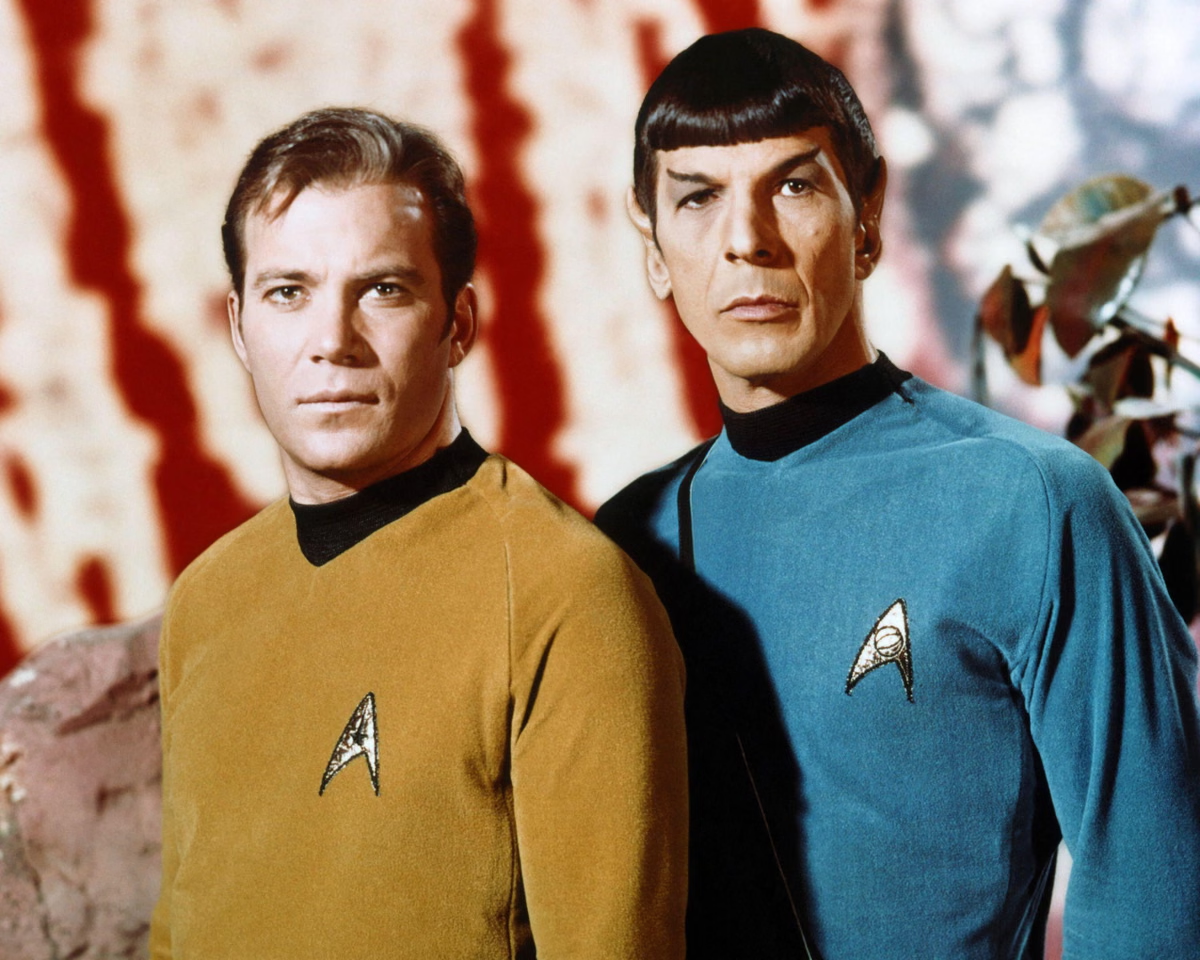
William Shatner, now 95, reflects on the enduring mystery of time as the science fiction phenomenon Star Trek reaches its 60th anniversary on September 8. The franchise, which began in the idealistic 1960s, was built on a utopian vision of a future where humanity prioritizes exploration over conquest, and where reason and empathy overcome tribalism. This legacy remains a significant mirror to American politics, even as the show faces modern challenges.
Reflecting on his casting in 1965 after NBC rejected the original pilot featuring Jeffrey Hunter as Captain Pike, Shatner recalls the process via Zoom from his Los Angeles home. He found the initial pilot interesting but somewhat ponderous, leading him to suggest a lighter touch. That adjustment helped secure the show’s success. Shatner brought a charismatic, athletic energy to the role of Captain Kirk, a character often viewed by modern right-wing critics as an all-American hero, despite Shatner being Canadian.
The show’s progressive roots were cemented in 1968 when Shatner and Nichelle Nichols, who portrayed Lt. Nyota Uhura, performed television’s first high-profile scripted interracial kiss in the episode “Plato’s Stepchildren.” While Shatner remains somewhat reluctant to be labeled a civil rights activist, the moment remains a landmark in television history. The series consistently pushed boundaries, featuring a meritocratic bridge crew that challenged the era’s all-white television norms.
Today, Star Trek finds itself in a complex position. While it continues to advocate for a United Federation of Planets that has moved past racism and nationalism, it faces criticism from figures like Stephen Miller, a former White House official who has targeted the show’s inclusiveness. Shatner dismisses such criticism as bizarre, questioning the logic behind political figures obsessing over television content. He rejects the notion that the show has “gone too far,” noting that such boundaries are arbitrary.
The franchise’s ideological underpinnings have long sparked debate. Billionaire Peter Thiel once famously contrasted Star Wars as a capitalist narrative with Star Trek as a communist one, citing the absence of currency in the 23rd-century vision created by Gene Roddenberry. Shatner, who traveled to space at age 90, remains wryly amused by such interpretations, acknowledging Thiel’s success while maintaining his own perspective on the show’s themes.
Industry experts like Mark Altman, co-author of “The Fifty-Year Mission” and director of the documentary “The 60-Year Mission,” argue that the show’s creators—Roddenberry, a World War II bomber pilot, and writer Gene Coon, a former Marine—infused the series with a deep-seated abhorrence of war born from their own harrowing experiences. This pacifist ethos was evident in episodes like “Arena,” where Kirk chooses mercy over the execution of a defeated enemy.
The evolution of the franchise reflects the changing political climate of the United States. Altman notes that while the original series mirrored the Kennedy-era “New Frontier,” subsequent iterations like “The Next Generation” aligned more with the consensus-building approach of George H.W. Bush. Later series, such as “Deep Space Nine,” were influenced by the societal shifts following the 1992 Los Angeles riots, while more recent entries have grappled with a post-9/11 world that often leans toward the apocalyptic.
As Paramount navigates a $8 billion merger with Skydance Media and considers a potential $110 billion acquisition of Warner Bros, the future of the Star Trek brand remains uncertain. Despite the cancellation of recent projects amid claims of being too “woke,” the franchise continues to offer a vision of utopia in an era of dystopia. The latest installment, “Starfleet Academy,” features Oscar-winner Holly Hunter, signaling that the mission to explore the final frontier continues despite the turbulence of the current cultural landscape. The report also notes that “Not just the passage of time and our perception of it, but what is time. The report also notes that isn’t it, 60 years, in terms of what time is, it really is meaningless. The report also notes that on the other hand, Dolly Parton just died. The report also notes that it brings up the whole concept of the passage of time and what that means. The report also notes that in an episode called The City on the Edge of Forever, Shatner’s Kirk travelled back in time and fell in love with a pacifist (Joan Collins) only to discover that she must die to prevent Nazi Germany winning the second world war. The report also notes that such ethical quandaries help explain why Star Trek will celebrate its 60th anniversary on 8 September not just as a force in US culture but a mirror held up to the country’s politics. The report also notes that big government and big tech were liberators from scarcity and inequality. The report also notes that star Trek’s fans included Martin Luther King and his wife, Coretta, who said it was the only programme they allowed their little children to stay up and watch.