

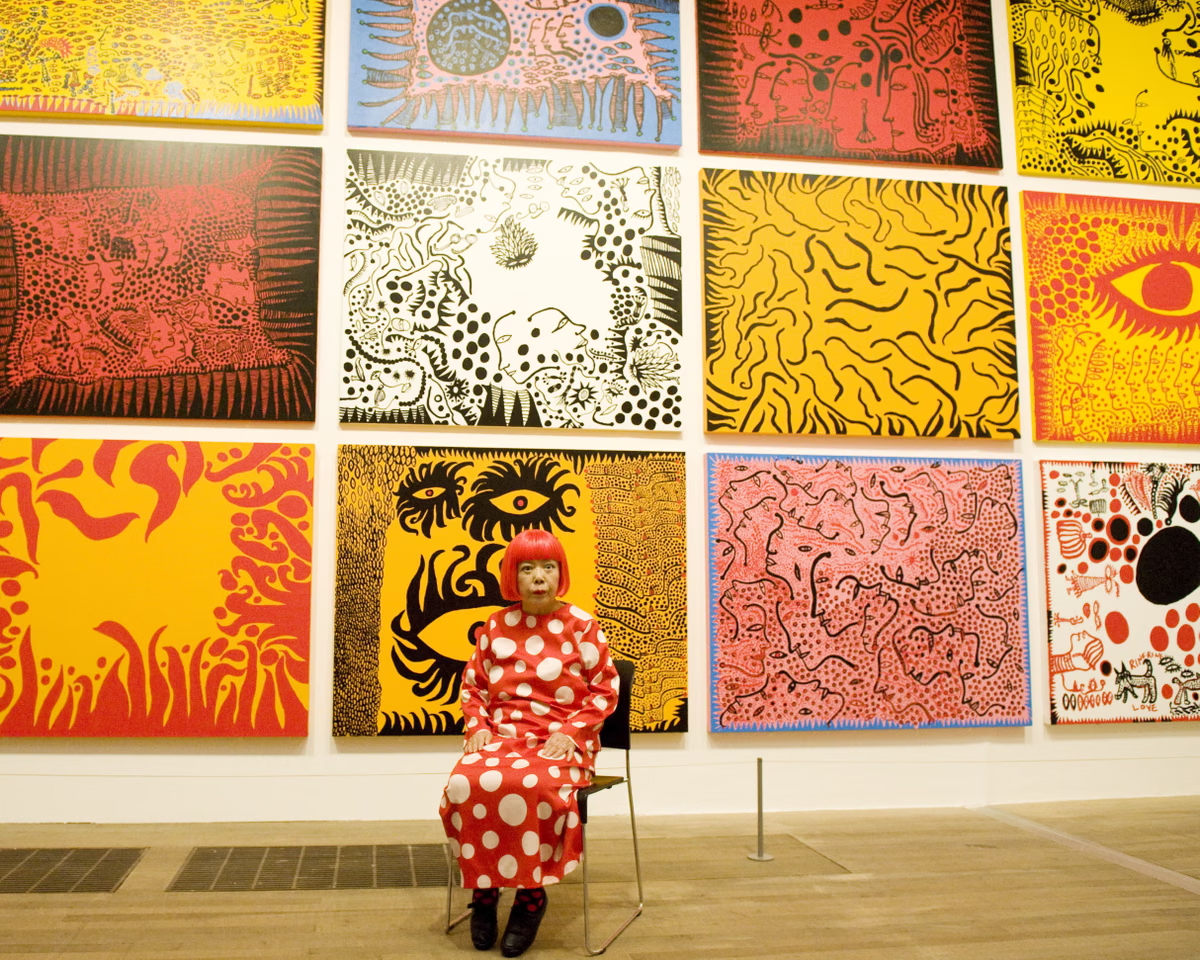
Yayoi Kusama, the visionary Japanese artist who passed away at the age of 97, leaves behind a legacy defined by her ability to channel profound personal struggle into transformative creative expression. From the age of 10, Kusama experienced vivid hallucinations, which she described as “flashes of light, auras, or dense fields of dots.” These visual and auditory disturbances became the foundation of her artistic obsession. A 1939 drawing of a woman in a kimono—believed to be her mother—depicts the figure being consumed by these dots, a motif that would persist throughout her career.
Kusama often spoke of the overwhelming nature of these visions, noting how patterns on a tablecloth would expand to cover walls, ceilings, and eventually her own body. She once described this sensation as feeling as though she were beginning to “self-obliterate” and being reduced to “nothingness” within the infinity of space and time. For Kusama, the act of creating art was a vital survival mechanism. In a 2012 interview, she reflected on this, stating, “I fight pain, anxiety, and fear every day, and the only method I have found that relieved my illness is to keep creating art. I followed the thread of art and somehow discovered a path that would allow me to live.”
Her commitment to her practice propelled her to the forefront of the New York avant-garde, where she became a major influence on the pop art movement. Her work, characterized by repetitive patterns and immersive installations, resonated deeply with global audiences. The popularity of her “Infinity Mirror Rooms” was so immense that Tate Modern in London extended her 2022 exhibition until 2024 to accommodate public demand. Despite the stigma surrounding mental health, Kusama remained transparent about her experiences, voluntarily checking herself into a Tokyo mental-health facility in the 1970s while continuing to work from a nearby studio.
The contemporary art world has become increasingly receptive to neurodivergent perspectives, recognizing the unique value of diverse cognitive experiences. This shift is evident in the recognition of artists like Nnena Kalu, an autistic artist with a learning disability who won the Turner prize last year, as well as the retrospective analysis of figures like Louis Wain and Andy Warhol through the lens of neurodiversity. Organizations such as ActionSpace, which supports learning-disabled artists, emphasize that the art world is significantly enriched by these varied voices, which challenge traditional notions of creativity.
Kate Adams, director and co-founder of the collective Project Art Works, notes that Kusama’s practice effectively channeled her intrinsic compulsions. Rather than seeking to escape these sensory experiences, Kusama’s installations—such as her signature dot-covered environments and light-filled rooms—transformed them into intense, patterned, and magical realities. Adams highlights that while conditions like OCD and neurodivergence are distinct, they often overlap, particularly when anxiety impacts an individual’s well-being. This intersection of sensory sensitivity and artistic output is increasingly understood, with sensory-friendly spaces now becoming more common in public institutions.
Kusama’s influence extends beyond her technical innovations; she provided a roadmap for how art can serve as a bridge between internal turmoil and external connection. As she frequently remarked, art was the singular force that prevented her from ending her life. While neurodivergent and disabled artists continue to navigate systemic barriers, Kusama’s enduring body of work stands as a testament to the power of artistic expression in processing the complexities of the human mind. The report also notes that “I was looking at the red flower patterns of the tablecloth on a table, and when I looked up I saw the same pattern covering the ceiling, the windows and the walls, and finally all over the room, my body and the universe. The report also notes that “The art world is richer for it, and their work continues to challenge us to recognise and celebrate the many voices that shape it.”. The report also notes that her exhibitions and major retrospectives draw huge crowds. The report also notes that in this way, we were granted a powerful glimpse through Kusama’s eyes. The report also notes that “Kusama’s practice seemed to channel the intrinsic auditory, repetitive and hallucinatory compulsions that she experienced,” says Kate Adams, director and co-founder of Project Art Works, a collective of artists with complex needs, and their collaborators who were nominated for the Turner prize in 2021.