

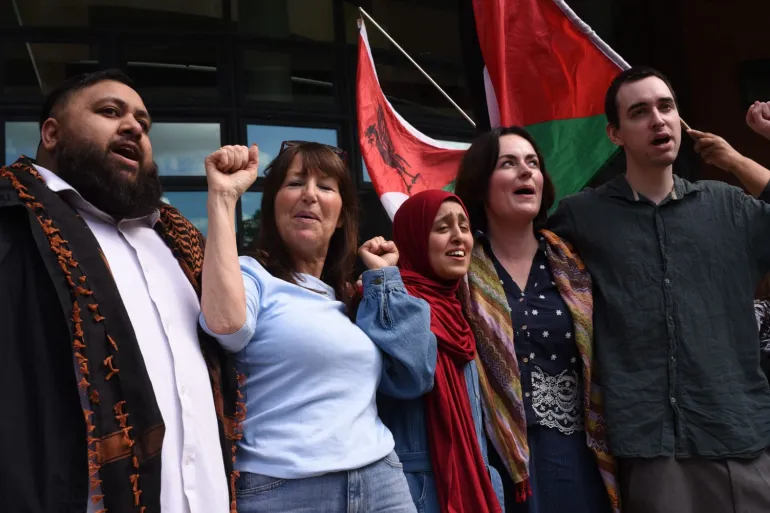
A judge at Preston Crown Court has ruled that five activists associated with Palestine Action will not be sentenced under terrorism legislation. The decision follows their June conviction for causing 212,000 pounds ($290,000) in damage to a Barclays bank branch in Burnley, Lancashire, during an August 2024 protest against the bank’s ties to Israeli weapons manufacturer Elbit Systems.
The defendants—Brendon O’Hagan, 28, Amanda Kelly, 31, Hmeera Atiqnisar, 31, Mohammed Malik, 28, and 70-year-old Alma Yaniv—are scheduled for sentencing on September 4. Outside the courtroom, supporters celebrated the ruling with cheers and chants, marking what family members described as a significant victory for the right to protest.
In a joint statement, the group expressed relief that the court rejected the application of terrorism sentencing, noting that the possibility was never disclosed during their trial. They emphasized that they were prosecuted for criminal damage, not terrorism, and that the classification should never have been considered an option.
The legal uncertainty arose after trial judge Philip Parry indicated he would consider whether the offense carried a “terrorist connection.” This move mirrored a previous case at Woolwich Crown Court, where four activists were sentenced as terrorists for a protest at an Elbit Systems site in Filton, despite the action occurring years prior to the group’s official proscription.
Raj Chada, a criminal defense lawyer at Hodge Jones & Allen, criticized the government’s application of these laws. He noted that while the relevant legislation has existed for years, it is being uniquely applied to target Palestine Action members for offenses that predated the group’s ban. According to Chada, this approach focuses on the nature of the protest rather than the specific actions of the individuals involved.
The political climate surrounding these cases remains intense. Since Palestine Action was proscribed in July 2025—placing it in the same legal category as groups like al-Qaeda and ISIL—more than 3,500 people have been arrested for expressing support, according to the rights group Defend our Juries. Many of these individuals, including a significant number of people over age 60, have faced legal action for participating in sit-ins at Parliament Square.
Amnesty International UK has called for an immediate end to the use of counter-terrorism powers against direct-action protesters. Kerry Moscogiuri, head of the organization, urged the government to lift the proscription on Palestine Action and reverse what she described as a long-term erosion of the fundamental right to protest, which she identified as a vital tool for democratic accountability. The report also notes that malik’s mother, Dove Malik, told, “It’s a victory for us, it’s a victory for Palestine, it’s a victory for protesting … We are on the right side of history.”. The report also notes that “We were on trial for charges of criminal damage, for damaging some windows and spraying red paint on a Barclays branch. The report also notes that neither the defendants nor the jury were aware that terrorism charges might be involved. The report also notes that “Certainly, in our experience, using the law like this is very, very unusual and appears to be being used to target Palestine Action activists whose offence predates the banning of the group,” he said. The report also notes that where protesters held signs reading, “I oppose genocide, I support Palestine Action.”, many of these arrests have arisen through repeated mass sit-ins in central London’s Parliament Square. The report also notes that one of the most effective tools we have to hold our leaders to account.”, the government should begin the process of reversing the years of attacks on our right to protest.