

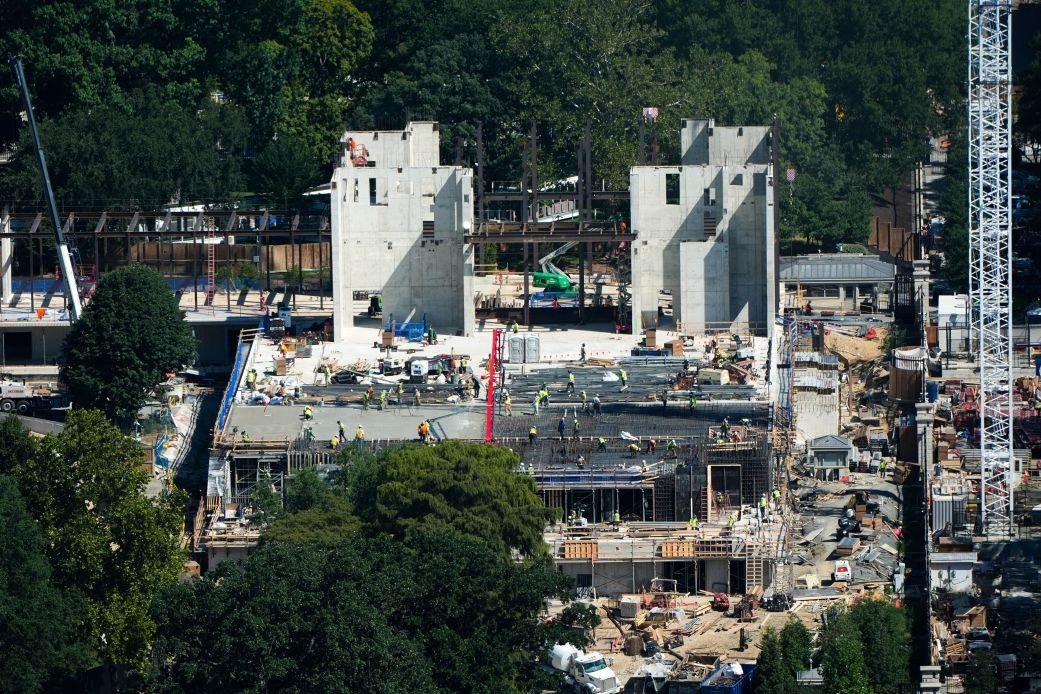
The Supreme Court has intervened in the ongoing legal battle over a massive ballroom project at the White House, issuing an order that allows construction to proceed for the time being. This decision effectively freezes a lower court ruling that would have mandated a total work stoppage by midnight on Friday. Chief Justice John Roberts, who oversees emergency matters originating from the DC Circuit Court of Appeals, issued the administrative stay without setting a specific deadline, meaning the project will continue until the justices issue a further directive.
The current order does not resolve the underlying legal dispute regarding the project’s legitimacy. Two previous courts have ruled that the construction is unlawful because it lacks the necessary congressional authorization. The Supreme Court’s move is intended to provide the justices with additional time to evaluate the administration’s request for an indefinite pause on those adverse rulings. Because the stay was handled administratively by Roberts, there was no public vote count, dissent, or formal reasoning provided, though the case is expected to be referred to the full bench.
According to filings submitted by the administration, the project is moving forward at an aggressive pace, with a 250-person crew operating on 20-hour shifts, seven days a week. The government reported that the ballroom complex is currently “65% complete in its entirety.” Solicitor General D. John Sauer argued that the construction is essential for national security, citing architectural values and threats to the president’s life. Sauer characterized the previous judicial injunctions as “judicial overreach,” asserting that the president, as the elected head of the Executive Branch, has the authority to secure and renovate the White House grounds.
The project has faced significant scrutiny since President Trump, a former real estate developer, began efforts to reshape the White House to his personal specifications. The demolition of the former East Wing to accommodate the event space triggered widespread criticism. Trump has defended the project, stating in August, “This will be the greatest military complex slash ballroom anywhere in the world. There won’t be anything like it.” Sources familiar with the president’s perspective indicate he views the ballroom and related renovations as a central component of his legacy, labeling those who oppose the construction as disloyal.
The National Trust for Historic Preservation initiated the lawsuit last December, successfully convincing a federal judge, Richard Leon, to halt work until Congress granted approval. While Judge Leon initially allowed the construction of a sophisticated bunker beneath the site—accepting the administration’s claim that it was distinct from the ballroom—the distinction blurred as officials increasingly cited national security needs for the entire structure. In early August, the DC Circuit Court of Appeals upheld the injunction in a 2-1 decision, declaring that the Executive Branch does not have unfettered authority to redesign the “People’s House” without congressional consent.
A core point of contention involves the legal standing of the National Trust. The administration argues the group lacks the right to sue, specifically targeting the testimony of architectural historian Alison Hoagland, who claimed her enjoyment of the site was diminished by the project. Trump dismissed this argument this week, stating, “The person said she walked along and she didn’t like the view, even though nothing was built. The woman has absolutely no standing.”
Financial details regarding the project remain a point of debate. While the administration initially estimated costs at $200 million, Trump later suggested the figure was “about $300 million” and claimed this month that nearly $400 million had been spent. However, internal documents obtained by The Washington Post indicate that the total cost for the ballroom and other modifications, including a new helipad and Rose Garden changes, is approximately $900 million. Lawyers for the National Trust have urged the Supreme Court to reject the administration’s request, arguing that the use of specialized, near-permanent concrete is a deliberate attempt to “outrun judicial review” by making the construction irreversible. The report also notes that with a 250-person crew working 20-hour days, 7 days per week, according to a filing submitted by the Trump administration to the Supreme Court, construction has been progressing rapidly. The report also notes that the court agreed with the judge in a divided ruling that required work to cease starting August 21, but in early August. The report also notes that roberts is certain to refer to the case to all nine justices. The report also notes that with his destruction of the former White House East Wing last year to make room for the event space causing consternation on both sides of the aisle, the ballroom project has been the most substantial part of that effort. The report also notes that the administration revealed how much construction had progressed in recent months, in asking the justices to step into the dispute. The report also notes that filings submitted to the court said hundreds of workers were spending “20 hours a day, 7 days a week to keep the project ahead of schedule and under budget,” and that it was already more than halfway done. The report also notes that sauer said that among the building materials being used is a type of concrete that is also used at nuclear power plants and nearly impossible to deconstruct.