

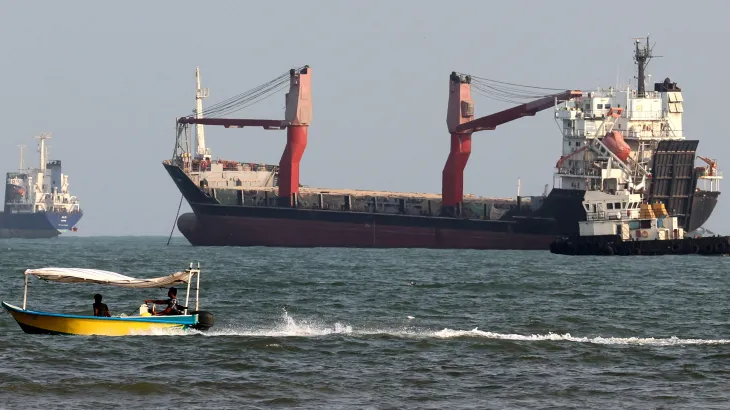
United States President Donald Trump has maintained that American military forces retain control over maritime traffic in the Strait of Hormuz. Despite Iranian assertions that the waterway is closed to any vessel lacking Tehran’s authorization, the US administration insists the passage remains open. This geopolitical standoff has further intensified, with Trump recently threatening to bomb Oman, a US ally situated on the opposite side of the strait from Iran.
Determining who truly governs the strait has become a complex challenge amid conflicting claims. To understand the reality on the ground, analysts are looking at movement data for vessels traversing the region. Before the current conflict, the Strait of Hormuz was treated as a unified waterway where navigation decisions were dictated by port calls, charter agreements, and safety protocols rather than military intimidation.
The war has effectively fractured the strait into two distinct corridors. The northern route is dominated by Iran, while the southern route, closer to the Omani shoreline, is the path favored by Washington. Data from the maritime intelligence firm Kpler provides a clear picture of how these tensions are influencing shipping behavior between August 1 and August 19.
During this nineteen-day period, 112 vessels carrying crude oil, liquefied petroleum gas (LPG), and liquefied natural gas (LNG) passed through the strait. Of those, only 21 openly utilized the Iranian route, while a mere two followed the Omani path. The remaining 89 vessels—representing over 80 percent of the oil and gas traffic—opted for “dark” or unclassified routes. This practice involves disabling a vessel’s Automatic Identification System (AIS) transponder, making it nearly impossible to track their precise movements or confirm their chosen path.
When looking at broader maritime traffic, including cargo ships, the trend remains consistent. Kpler recorded 236 total transits through the strait in the same period. While 83 ships openly used the Iranian route and only three publicly navigated the Omani route, the vast majority—148 vessels—chose to go dark. This means more than six out of every ten ships passing through the area are actively attempting to mask their identities and locations.
The primary motivation for disabling transponders is self-preservation. Since the conflict began, both the US and Iran have engaged in aggressive military actions, including bombing vessels they accuse of violating their respective maritime rules. For instance, on August 11, the US Navy fired Hellfire missiles at the Panama-flagged cargo vessel Vela Nova, claiming it failed to follow orders to change course. Similarly, the United Arab Emirates reported that Iran attacked an ADNOC-owned tanker with a missile on August 8. ADNOC has stated that 15 of its vessels have been targeted by drones or missiles since the war’s inception.
Beyond avoiding military targeting, experts note that ships are using dark routing to facilitate clandestine ship-to-ship cargo transfers. These mid-route operations allow countries like Saudi Arabia, Iraq, and Kuwait to move shipments without public scrutiny. Furthermore, Iranian vessels have been observed using the Omani route to conduct transfers, effectively rebranding their exports to bypass international sanctions.
The persistent use of dark routing makes it difficult to definitively state which power holds the upper hand in the strait. However, the data suggests that shipping operators are significantly more wary of Iranian influence than American pressure. As long as these vessels perceive that the risks of being identified outweigh the benefits of transparency, the Strait of Hormuz will remain a high-stakes environment where silence is the preferred strategy for survival.
The economic impact of this instability is evident in global oil prices. Brent crude, which traded at approximately $66 per barrel before the conflict, has seen significant volatility, surging past $100 on several occasions and reaching a high of $119 in March. As of Thursday morning, the benchmark stood at $92.9 per barrel. Analysts suggest that if Tehran’s ability to disrupt these shipping flows is perceived to be waning, it could diminish one of its primary levers of power in ongoing negotiations with the United States. The report also notes that on Tuesday, he also claimed that the strait was open for vessels to pass through, despite Iranian insistence that the waterway was closed for all ships that don’t seek Tehran’s approval before transit, and even though the US itself has a naval blockade in place targeting all Iran-linked ships. The report also notes that at the same time, Trump has threatened to bomb Oman, a US ally that sits across the Strait of Hormuz from Iran – the waterway lies in the maritime territories of Iran and Oman – in an apparent bid to dissuade Muscat from striking any deal with Tehran to jointly manage the strait. The report also notes that the Strait of Hormuz was largely considered a single waterway, without distinctions between “Iranian” or “Omani” routes, and ships entered and exited along well‑established traffic separation schemes, mostly along the central part of the strait, before the war started. The report also notes that tehran insists on the northern, Iranian route, hugging Iran’s coast near Larak Island and Qeshm Island, and feeding directly into Iranian ports and offshore terminals. The report also notes that “While these transits can be observed once vessels reappear after crossing, the nature of dark routing makes it highly difficult to determine what proportion may also have used the Omani route or to confirm their precise routing from the available data,” Mohamed Rafik Halitim, a customer success manager for maritime and commodities at Kpler, told. The report also notes that but others carrying dry cargo and chemicals, this includes not just oil and gas vessels. The report also notes that but the bulk of the ships, 148 of them, again went dark or used unknown routes while transiting through the strait. The report also notes that that’s more than six out of 10 ships that passed through Hormuz in this period.