

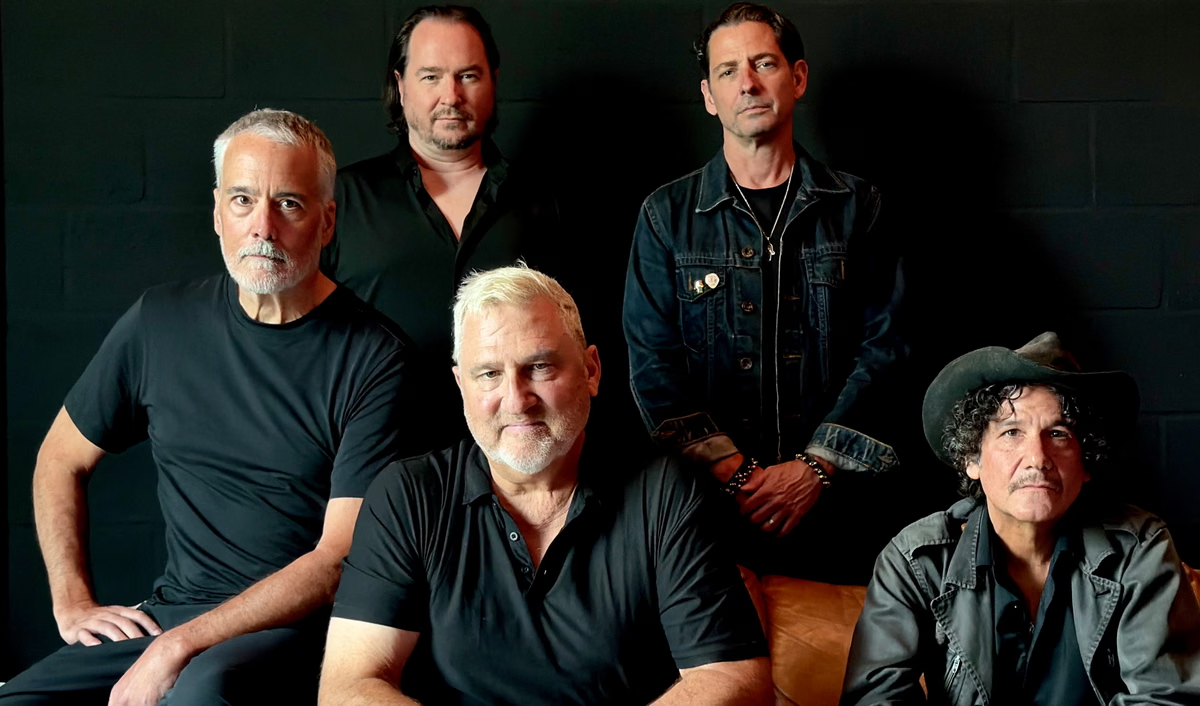
The Afghan Whigs were always heavier than their grunge-era contemporaries, though not in the traditional sense. Their turbulent, sophisticated rock was rooted in soul and funk, and frontman Greg Dulli notes that the group only embraced distortion to be heard over the volume of metalhead drummer Steve Earle’s playing. “Any kind of jangle wasn’t gonna work,” Dulli explains.
“My songs acknowledge consequence, more than they deal in judgment,” Dulli says, between sips of water in the bar of a London hotel. Forty years after their formation, the Whigs are resurgent. Their new album, Soft Control, holds its own with earlier dark masterpieces such as their 1993 breakthrough Gentlemen and the bleakly funky 1996 follow-up, Black Love, records that cemented Dulli as alt-rock’s poet of arch romanticism.
Possessed of devilish charm, Dulli was raised Catholic during a “very Huckleberry Finn childhood” in Hamilton, Ohio. “I was an altar boy,” he grins. “My attitude was, if I’m going to church, I might as well be on stage. I had a great seat, could scope out the talent. Clearly, I was into the attention.” By age 12, however, he was asking hard questions, eventually telling his mother he would no longer attend church because he did not believe in it. Dulli leers as he notes that he sings, “We both know God ain’t real, baby,” on one of the new album’s tracks.
Dulli’s father was not a constant presence, so he was raised by his mother, grandmother, and aunts. “When you’re surrounded by ladies you gotta work hard to get away with stuff, because they’re vigilant. But they were also nurturing, supportive and encouraging.” His mother possessed a killer record collection, featuring Motown 45s and the soundtrack to Jesus Christ Superstar, which helped shape his musical sensibilities. He notes, “I understood sorrow and loss and loneliness from an early age. I had been there, so why wouldn’t I explore it?”
He played his first gig at 14, wrote his first song at 15, and spent his college years in the pit for shows by the Ramones, Hüsker Dü, and Black Flag. Inspired, he formed the Black Republicans, whose shows were frequented by a bearded guy who regularly told him, “I’m better than your bassist.” That man was John Curley, who eventually asked if he and guitarist Rick McCollum could sit in. Soon, the Black Republicans were finished, drummer Earle was enlisted, and the Afghan Whigs were born. Their first rehearsal took place on Halloween 1986.
With their second album, 1990’s Up in It, the group became one of the first non-Seattle signings to the Sub Pop label, building a buzz with their eclectic live cover versions. While they had no desire to be a covers band, they learned songs quickly to fill their sets. The Whigs wore their influences on their sleeves, particularly soul music, covering tracks like Freda Payne’s Band of Gold, TLC’s Creep, and the Supremes’ Come See About Me. “That song is so desperate,” Dulli says. “Motown songs are dark, but the music is peppy and upbeat.”
As the Whigs completed their second Sub Pop album, Congregation, Nirvana became unlikely superstars. “Watching those dudes knock Michael Jackson off the No 1 spot… that escalated quickly,” Dulli says. When the post-Nevermind gold rush started, their lives changed, and the group signed with Elektra. Gentlemen was the product of Dulli’s “very stormy relationship” with a woman credited on the sleeve as Miss Ruby Belle. The album served as an examination of male ego, sexuality, and chauvinism. “I’d grown up surrounded by women, but I come from a very patriarchal society,” he says. “Homemakers stayed home, made babies and dinner and shut the fuck up. I had to learn how to be, for lack of a better word, a feminist.”
The band’s recent trajectory was unexpectedly influenced by R&B star Usher. After seeing the Afghan Whigs perform, Usher told the Fader that they were one of his favorite rock groups and that he wanted to impress the rock-leaning crowd. The show left Dulli and Curley energized in a way the reunion tour had not. “After that show, John and I had dinner and wondered if we could make an album,” he says. “I love playing with John.”
Soft Control is the fourth album since the band reunited, and it is the work of a 61-year-old more acquainted with mortality than he once was. The loss of Mark Lanegan, who died in 2022 before they could record a long-mooted second Gutter Twins record, still haunts him. Dulli remains philosophical about the nature of belief, noting that religion was invented “to comfort people because they’re afraid of dying.” Today, he reflects on his past work with a critical eye, noting that midway through touring Gentlemen in 1993, he struck the song Be Sweet from the setlist, never to return. “It was a great lyric,” he says, acknowledging the complexity of his own evolution. The report also notes that “Any kind of jangle wasn’t gonna work.” But Dulli’s lyrics, inspired by the likes of Motown bards Holland/Dozier/Holland, were pitch-black, depicting lovers in co-dependent cycles of betrayal and recrimination. The report also notes that punishment inevitable and some kind of judgment inescapable, afghan Whigs songs take place in a world where sin is irresistible. The report also notes that his dad was the youngest of 14; several of Dulli’s uncles died when he was young. The report also notes that like, what’s with all the kid killing. The report also notes that ‘God so loved the world that he gave his only begotten son’. The report also notes that as would that of his first gig: psychedelic soulsters the 5th Dimension at Ohio state fair in 1973, their influence would prove indelible. The report also notes that “I developed a crush on Marilyn McCoo immediately. The report also notes that and her husband – Billy Davis Jr – went off on his full-on gospel lift, they did Let the Sunshine In.