

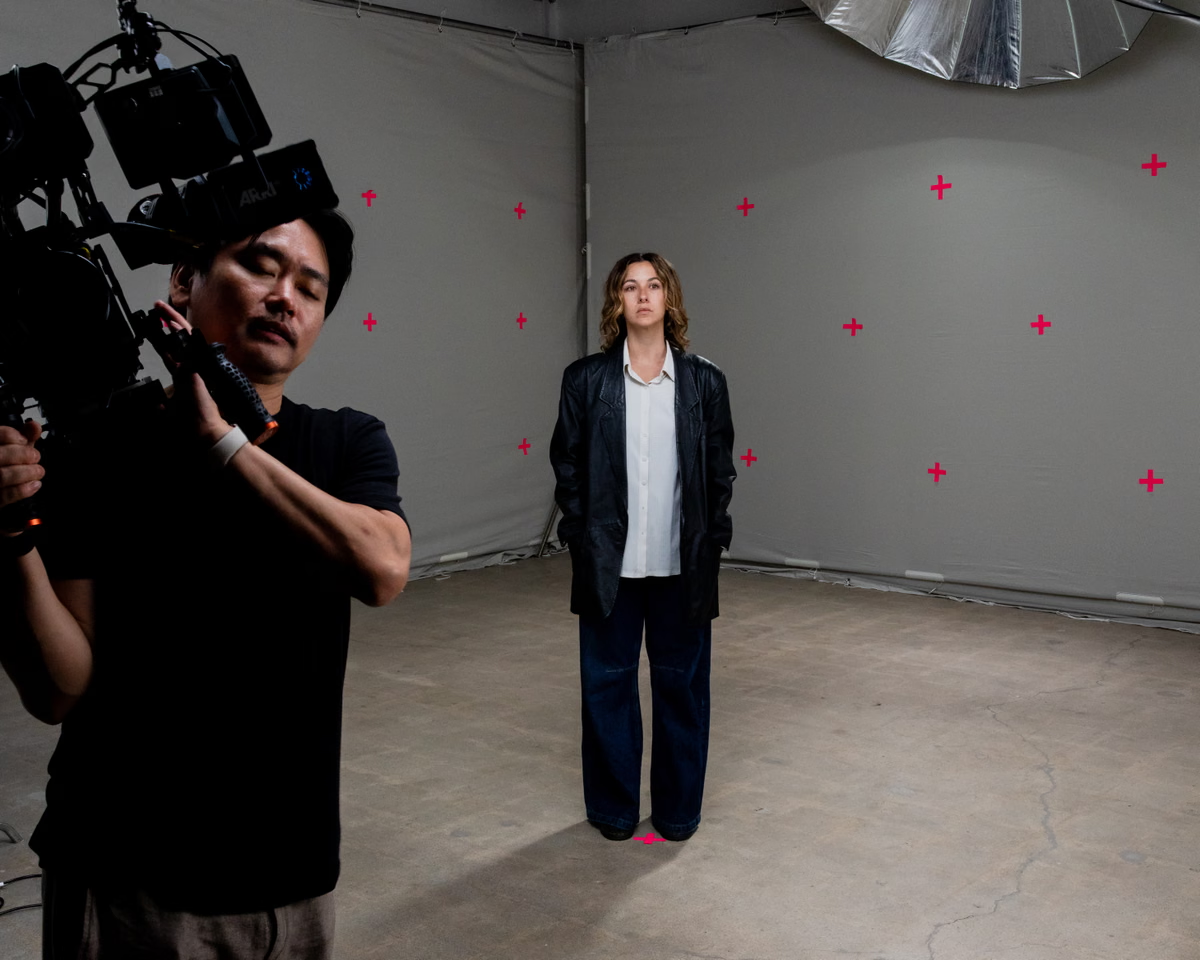
In the shadow of Sony Pictures’ historic Culver City lot, a new breed of production house is challenging the traditional Hollywood model. Promise, a studio built on the potential of artificial intelligence, operates from modest premises that stand in stark contrast to the massive sound stages of industry giants. By leveraging rapidly advancing AI models—including both US-developed software and market-leading Chinese tools—these newcomers are producing films with complex backgrounds, sophisticated special effects, and synthetic performers, effectively reducing their reliance on traditional studio financing and infrastructure.
The shift is already visible in practice. During a recent shoot for the horror film Touch Grass, which carries a budget in the low millions, actor Tori Thomas performed in a simple office space draped with white sheets. Using the newly released Chinese AI model Seedance 2.5, the production team superimposed her movements in real time onto a field of swaying grass. The technology allowed the director to view finished scenes on a handheld monitor instantly, with the AI even rendering subtle environmental details like moving seedheads. This capability, according to Promise co-founder George Strompolos, could make hybrid AI-human productions 20% to 50% cheaper than conventional methods.
This technological integration is spreading rapidly across the industry. Netflix reported using AI in 300 of its 1,000 titles throughout 2026. Meanwhile, veteran director Ron Howard has partnered with the new AI studio Obsidian to produce an animated documentary about Vietnam-era prisoners of war. Even high-profile figures like Brad Pitt have weighed in, suggesting that AI could serve as a vital tool for securing the production of mid-budget films ranging from $40 million to $90 million.
Despite the enthusiasm, the rise of AI in cinema remains deeply polarizing. Prominent directors such as Christopher Nolan and Guillermo del Toro have voiced strong criticism, while unions and political figures express grave concerns regarding labor displacement. Democratic congresswoman Laura Friedman, representing Hollywood’s creative workforce, warned that the industry cannot afford to wait until tens of thousands of American workers are displaced by these tools. Public backlash has also intensified following controversial projects, such as the AI-assisted resurrection of the late actor Val Kilmer and the emergence of digital “actors” like Tilly Norwood, with performers like Emily Blunt publicly pleading for the preservation of human connection in film.
Proponents of the technology, however, argue that it signals a new creative renaissance. Filmmaker Kavan “the Kid” Cardoza, founder of the studio Phantom X, compares the current climate to the independent film explosion of the 1990s. Cardoza is particularly impressed by Chinese AI models, which he believes are outperforming US counterparts because they are trained on vast, unrestricted datasets. He noted that if US intellectual property restrictions continue to hamper local development, he would consider moving his operations to China to maintain a competitive edge.
The technical transition is being embraced by industry veterans as well. Joel Hynek, an Oscar-winning special effects artist known for his work on the 1987 film Predator, views the shift to AI as a transformative leap comparable to the move from optical to digital film. While acknowledging the fear surrounding the technology, Hynek emphasized that he sees its incredible promise for simplifying complex production tasks.
The industry’s relationship with AI is often compared to plastic surgery: widely practiced but rarely discussed openly. D Ryan Reeb, an executive producer at Obsidian, noted that he has met with dozens of major production companies eager to adopt these tools, anticipating that widespread integration is inevitable. Obsidian, which operates out of Imagine Entertainment’s Beverly Hills headquarters, estimates that AI technology provides cost savings of 30% to 40%.
Ultimately, the debate centers on the balance between creative empowerment and corporate consolidation. Producer Joanna Popper noted that while AI allows talented storytellers to bypass traditional gatekeepers, there is a significant risk that a small number of tech companies could monopolize the financial gains of the industry. As Promise and similar studios continue to push boundaries, the question remains whether this technology will lead to a golden era of independent creativity or a fundamental erosion of the human element in storytelling. The report also notes that a new studio feeding off the potential of AI, can glimpse the lots where Singin’ in the Rain and Men in Black were shot, but no longer do they need to get beyond the studio’s high walls to make their visions come true, the artists at Promise. The report also notes that backed by Google, Silicon Valley venture capitalists and Disney, Promise is one of a rising number of AI film studios now taking root in Hollywood, with the result that traditional studios’ vast sound stages and financing are becoming less necessary. The report also notes that then the AI did the rest, a small camera followed Thomas as she scrambled in a chase scene. The report also notes that even the seedheads in the AI-generated meadow moved as Thomas appeared to brush past. The report also notes that the field was easily replaced by a nightmarish underground cavern, in another take. The report also notes that with a glance at the screen, Thomas could immediately see the backdrop she was acting with. The report also notes that brad Pitt said this week that while there was a lot of pushback, “AI is going to be the very thing that, if used as a tool, is going to help these mid-budget films, $40m- to $90m-budgeted films, get made.”. The report also notes that such as Kavan “the Kid” Cardoza, 37, who has set up the Phantom X studio, that chimed with predictions from a new wave of AI native film-makers.