

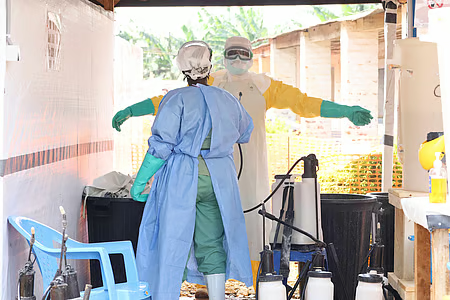
The Democratic Republic of Congo has reported a sharp surge in its ongoing Ebola outbreak, with government figures released Sunday confirming 4,120 cases and 1,887 deaths. This latest update marks a significant increase from the 4,053 cases and 1,850 deaths recorded just days earlier between August 5 and 6, according to data from the U.S. Centers for Disease Control and Prevention.
The current crisis, which involves the rare Bundibugyo strain of the virus, is now the second-largest Ebola epidemic ever documented, trailing only the 2014-2016 West Africa crisis. The World Health Organization (WHO) noted that the outbreak has accelerated rapidly, with figures rising from 3,605 cases and 1,587 deaths reported on July 30.
The virus has spread across five provinces—Ituri, North Kivu, South Kivu, Haut-Uélé, and Tshopo—impacting dozens of health zones. Health officials are particularly concerned that the official statistics may undercount the true scale of the transmission, as challenges in surveillance, contact tracing, and delayed detection persist across the affected regions.
Amid these rising numbers, health authorities moved to calm public fears in Kinshasa following a boat quarantine incident. On Thursday, over 200 passengers were isolated at the port of Maluku, located 65 kilometers from the capital, after a traveler who had been on the vessel died showing symptoms consistent with Ebola. However, the National Institute of Biomedical Research confirmed on Saturday that all suspected cases from the boat tested negative for the Bundibugyo virus.
The outbreak was officially declared a Public Health Emergency of International Concern on May 17, 2026. In response, the WHO and the Africa Centres for Disease Control and Prevention launched a $518 million continental response plan on June 5. Despite these efforts, WHO Director-General Tedros Adhanom Ghebreyesus has warned that the virus is spreading faster than the current response can manage.
The situation is further complicated by the region’s volatile environment, characterized by armed conflict, population displacement, and inadequate health infrastructure. Médecins Sans Frontières has cautioned that community transmission remains difficult to curb, and response capacity is currently insufficient to address the scale of the emergency. Additionally, labor disputes involving health workers over delayed or unpaid compensation have hindered operational efficiency.
The Bundibugyo strain presents a unique challenge, as there is currently no approved vaccine or specific treatment for this particular species. While researchers are actively evaluating potential medical countermeasures, they are not yet established tools for controlling the current surge.
The CDC highlighted the alarming speed of this outbreak, noting that it surpassed 1,000 confirmed cases within approximately 40 days of the response activation, a stark contrast to the 235 days it took to reach that threshold during the 2018 Congo outbreak. International health agencies emphasize that the primary concern remains the rapid pace at which new infections are being identified.
As the virus spreads through direct contact with infected bodily fluids or contaminated materials, authorities are racing to bolster early detection, isolation, and contact tracing. The international community continues to monitor the situation closely, warning that without a significant strengthening of the response, the outbreak will continue to outpace containment efforts.
The latest figures make it the second-largest Ebola outbreak ever recorded, behind the 2014-16 West Africa epidemic, according to Reuters.
Ebola cases in Congo top 4,000, no sign of slowing down
Uganda declares Ebola outbreak over after 42 days
Reuters reported that delayed detection, inadequate surveillance and difficulty tracing contacts mean some infections are likely going undetected.
Ebola cases in Congo exceed 2,000, including 754 deaths