

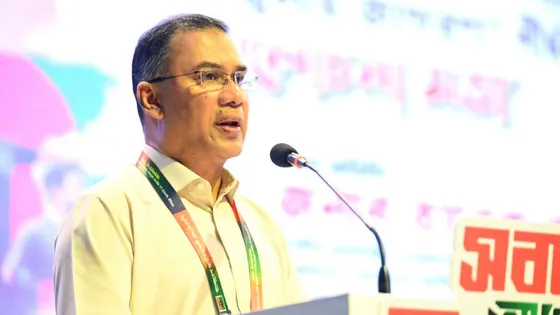
Prime Minister Tarique Rahman has stated that his government will not use excuses to evade its responsibilities, acknowledging the ongoing difficulties faced by the public. Speaking on Tuesday afternoon, August 4, at a discussion titled “The 17-Year Unrelenting Struggle for Democracy and the Bloody July Awakening” held at the Krishibid Institution Bangladesh (KIB) in Farmgate, Dhaka, he emphasized that the administration is continuously working to identify and resolve these issues.
Addressing the public’s suffering due to electricity and gas shortages, the Prime Minister admitted that citizens are enduring significant hardships. He attributed the current state of the energy sector to the previous fascist government, which he accused of treating the sector as a means to enrich themselves. He noted that rebuilding a sector so thoroughly devastated by years of looting requires time, though the government is doing its best to alleviate the situation using available experience and advice.
To combat the gas crisis, the Prime Minister announced that the government has initiated processes to import gas from Myanmar, with Malaysia also offering assistance. Reflecting on the state of the country upon taking office, Tarique Rahman described the economy, healthcare system, and administration as being in a fragile and fractured state, with every major national institution left in a ruined condition.
Tarique Rahman characterized the July-August movement as a genuine people’s uprising, asserting that its success belongs to citizens from all walks of life rather than any single individual or party. He credited the movement’s victory to the full involvement and desire for change among the general public.
Regarding the BNP’s 31-point reform agenda, the Prime Minister noted that the public’s support in the election has transformed it from a party platform into a mandate for the people. He reiterated that the core objectives of these 31 points are to establish the political and economic rights of the citizens and to serve as a comprehensive blueprint for the reconstruction of the state.