

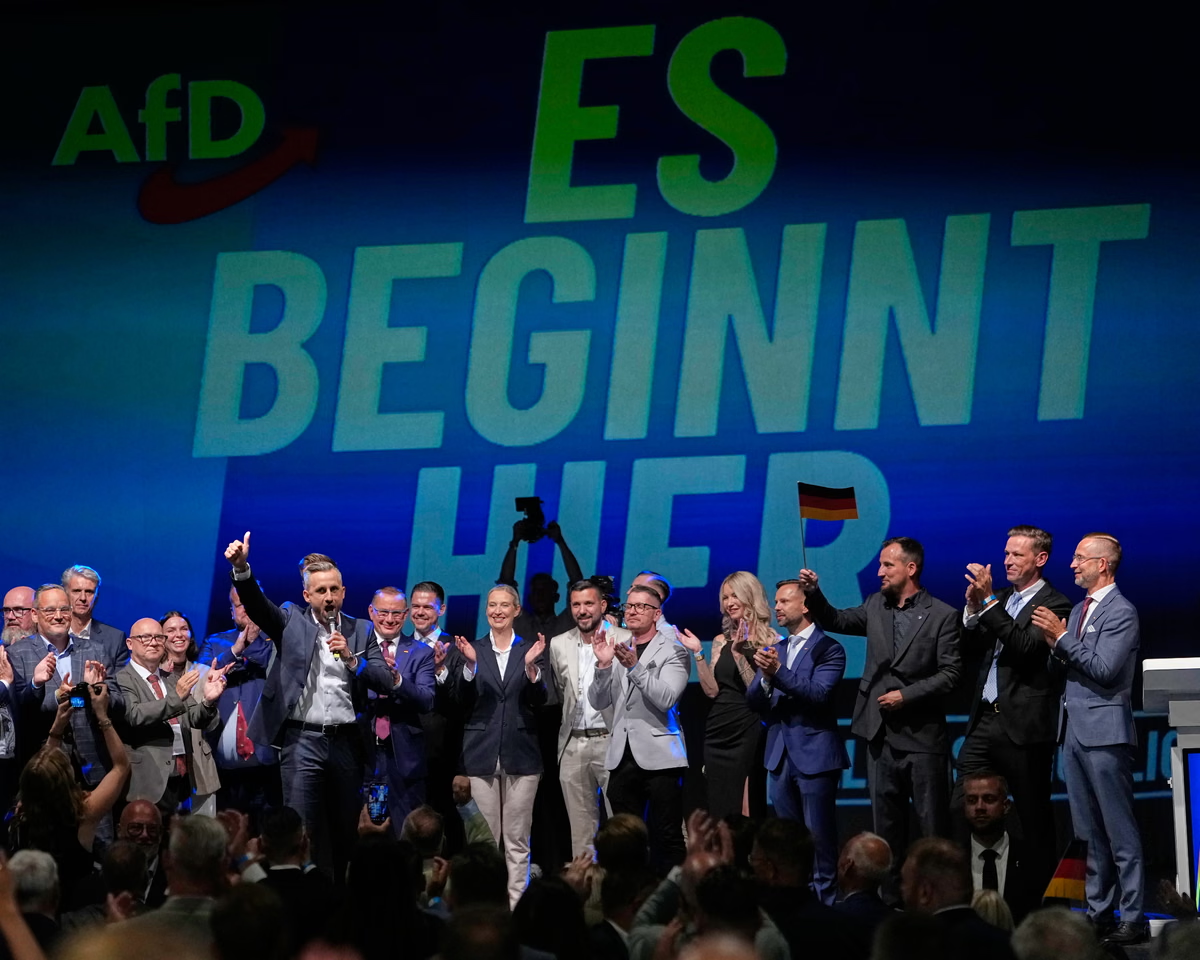
The Alternative für Deutschland (AfD) has achieved a historic electoral milestone in the German state of Saxony-Anhalt, securing 43.8% of the vote. This result, which nearly doubles the party’s previous standing, places the AfD closer to state-level governance than any far-right group since the second world war. The party, which has been labeled a confirmed rightwing extremist organization by Germany’s domestic intelligence agency, holds 39 seats in the 83-member parliament, falling just short of an outright majority.
This outcome has reverberated across the continent, drawing praise from nationalist figures who view it as a significant breakthrough, while mainstream leaders have expressed deep alarm. The political landscape in Germany saw a sharp decline for traditional parties; Chancellor Friedrich Merz’s centre-right CDU fell to 17.2%, less than half its performance from five years ago, while the centre-left SPD managed only 9.3%.
While Saxony-Anhalt has historically served as a far-right stronghold with support levels double the national average, the result coincides with a broader European trend. Research involving over 150 political scientists across 31 countries indicates that support for far-right parties in national elections has climbed to over 23% in 2026, a significant increase from roughly 10% a decade ago and 5% in 1995.
Far-right populist parties currently participate in ruling coalitions in nations including Croatia, Czechia, Italy, and Finland, while providing support to a minority government in Sweden. They also lead polling in countries such as Austria, Belgium, France, and Germany. Despite these gains, some parties have faced setbacks, notably in the Netherlands where Geert Wilders’s Freedom party lost seats last year, and in Hungary, where Viktor Orbán’s Fidesz party was defeated by a centre-right opponent in April.
Experts like Cas Mudde of the University of Georgia suggest that the far right has become an established political force whose electoral fortunes fluctuate like any other party. The ongoing rise of the AfD, which has been criticized for utilizing Nazi imagery and distinguishing between “biological” and “passport” Germans, remains a focal point of concern as France, Sweden, and other nations approach critical elections.
A central debate surrounds the effectiveness of the “cordon sanitaire,” or firewall, maintained by mainstream parties to exclude the far right from power. Some analysts argue that this strategy has backfired by shielding the AfD from the compromises of governance while leaving mainstream parties in unstable, ineffective alliances that frustrate voters. Mujtaba Rahman of the Eurasia Group describes this as a self-reinforcing dynamic where policy stagnation drives further support toward the extremes.
Conversely, other political scientists contend that the firewall is an insufficient explanation for the rise of these movements. Data from a study of over 1,300 governments across 57 countries suggests that far-right parties do not necessarily weaken once they enter government; in fact, they often gain strength. As researcher Gabriela Greilinger notes, the debate over the success of the cordon sanitaire may overlook the fundamental drivers of the current political shift.
Oxford University professor Tarik Abou-Chadi cautions against drawing overly broad conclusions from the Saxony-Anhalt result, noting that local political sociology varies significantly. Nevertheless, with the AfD leading in national polls and showing strength in regions like Mecklenburg-Western Pomerania and Berlin, the party’s influence continues to challenge the traditional European political order. The report also notes that a party that dabbles in Nazi imagery, distinguishes between “biological” and “passport” Germans, and is too extreme even for France’s far-right leader Marine Le Pen, nearly doubled its score in Sunday’s state election in Saxony-Anhalt to 43.8% of the vote, the numbers speak for themselves: Alternative für Deutschland (AfD). The report also notes that meanwhile, the centre-right CDU of the chancellor, Friedrich Merz, collapsed to 17.2%, less than half its total in the same race five years ago, and the centre-left SPD – Germany’s other main party of government for the past 60-odd years – scraped 9.3%. The report also notes that the least that can be said is that the centre did not hold. The report also notes that with nationalists cheering a “historic win” that is “just the beginning” and mainstream leaders warning of a “grave moment” for Europe, it has sent shock waves round Europe. The report also notes that france faces a crunch presidential ballot next spring. The report also notes that as well as in Italy, Spain and Poland, later in the year, key parliamentary races will follow there. The report also notes that it would be wise not to read too much into one election result in one quite particular German state. The report also notes that according to research led by Matthijs Rooduijn, a political scientist at the University of Amsterdam, a proportion that has grown nearly fivefold since the mid-1990s and climbed particularly steeply over the past three years, almost one in four voters in Europe now cast their ballot for far-right parties.