

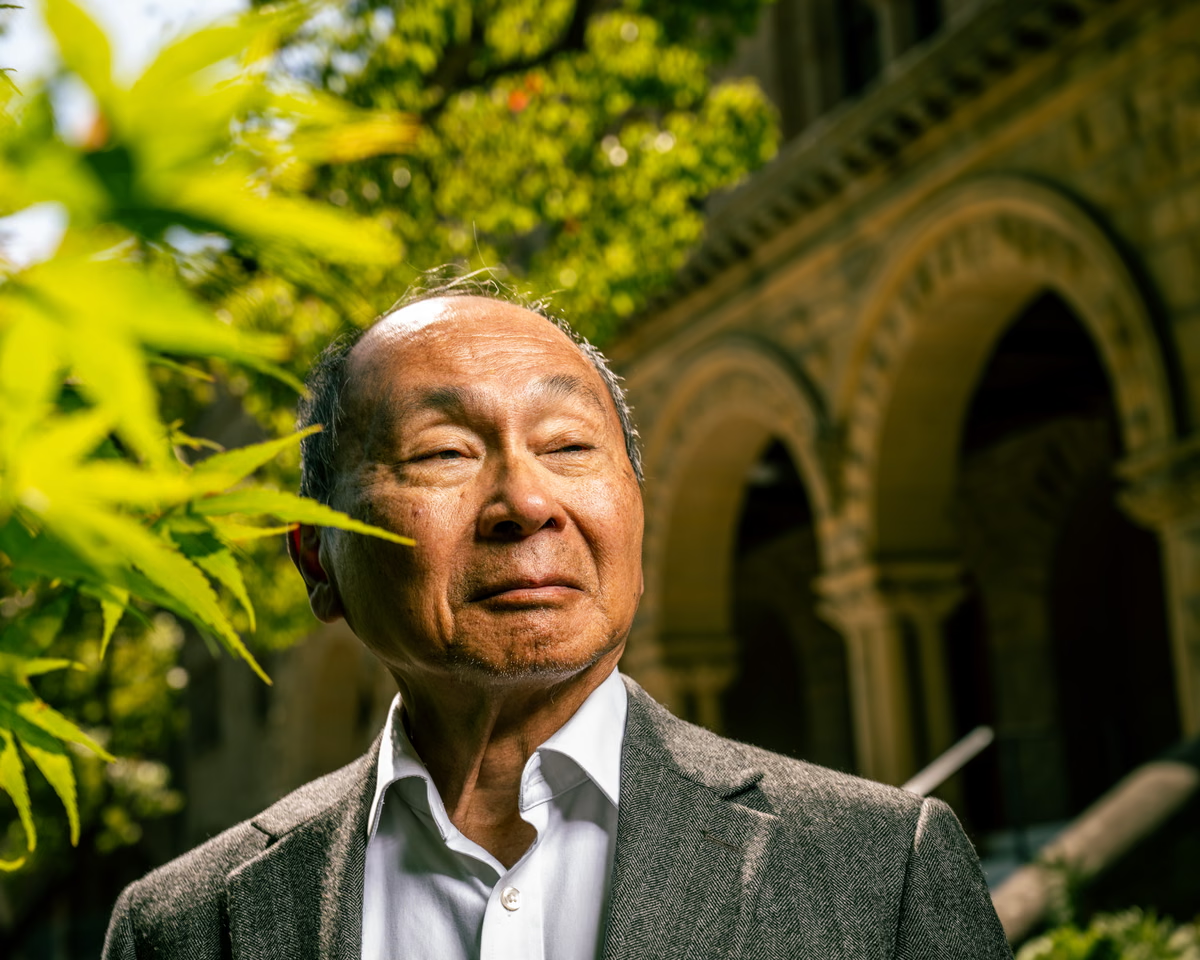
Francis Fukuyama, a political scientist whose work has been referenced by figures ranging from academic peers to the fictional Captain James T. Kirk in Star Trek VI: The Undiscovered Country, remains a central figure in discussions about the trajectory of global governance. In the 1991 film, Kirk’s reflection on the “end of history” echoed a sentiment that had become a shorthand for the post-Cold War era. Fukuyama, now 73, acknowledges that while he might have chosen a different title had he known the extent of the public reaction, the phrase was instrumental in gaining the attention his original 1989 essay received.
Published in the summer of 1989 within the pages of the National Interest, a right-leaning foreign policy journal, the 15-page essay introduced a thesis that would define Fukuyama’s career. At 36, he was a think-tanker whose work became a focal point for governments and corporations worldwide. Today, he views the persistent confusion surrounding his argument as a 37-year-old misunderstanding. Many readers interpreted his “end of history” claim as a prediction that human conflict and events were concluding with the fall of the Berlin Wall. In reality, he argues, the thesis was a nuanced application of Hegelian thought, influenced by the philosopher Alexandre Kojève.
Kojève defined the end of history as the emergence of a system that could not be improved upon in terms of satisfying human needs. He famously pointed to 1806, when Napoleon’s victory at the Battle of Jena-Auerstedt brought the Napoleonic Code to Europe, as a symbolic end point. Fukuyama explains that his own argument was not that liberal democracy was flawless or universally achieved, but that it represented the most compelling guiding principle for modern society. He notes that the 1789 revolution established the foundational principles of liberty and equality, which remain the benchmarks for a modern liberal order.
In his new memoir, Fukuyama seeks to clarify these intellectual foundations while revisiting his own shifts in perspective. The book serves as a narrative of a life in ideas, tracing his evolution from a disciple of conservative scholar Allan Bloom and a member of the neoconservative group that influenced the 2003 invasion of Iraq—a war he later renounced in February 2004—to his current outlook. The memoir also touches on his personal history, including his grandmother’s journey as a “picture bride” from Japan to Los Angeles and the financial ruin of his uncle, providing a personal backdrop to his broader political theories.
Addressing the current state of democracy, Fukuyama admits that the “liberal” component—the system of checks and constraints on power—is increasingly vulnerable. He points to the rise of alternative systems, such as Iranian-style theocracy, which he finds implausible as a superior model for human satisfaction. When asked about Donald Trump and his apparent disregard for democratic guardrails, Fukuyama describes it as a significant psychological question for future historians. He highlights Trump’s long-standing, unconventional affinity for figures like Vladimir Putin and his historical opposition to NATO as areas of concern that defy traditional political logic.
Fukuyama remains active on a video call from his California home, using a computer he built himself, and continues to engage with the public, even when faced with internet comments that mock his famous thesis. He maintains that his original warning—that the end of history might be a “very sad time”—was rooted in the concern that while liberal democracy provides stability and material comfort, it might fail to satisfy the deeper human need for thymos, or spiritedness. He continues to search for systems that might offer a more profound sense of fulfillment, though he remains committed to the principles of liberal democracy as the most viable framework currently available. The report also notes that but Francis Fukuyama is one of them, t here are not many public intellectuals who can say they’ve been cited by Capt James T Kirk of the Starship Enterprise. The report also notes that in Star Trek VI: The Undiscovered Country, William Shatner’s character is in a reflective mood, and speaks to the Klingon chancellor. The report also notes that “Well, we haven’t run out of history quite yet.”. The report also notes that you’d often hear comments like that, when the film came out in 1991 and in the years that followed. The report also notes that as we shall see, got lost, but these were subtleties that. The report also notes that philosopher and analyst, specialising in foreign policy and political economy, the essay made its author internationally renowned and helped power a career as a political scientist. The report also notes that from the C-suite of Ford to the tent of the Libyan dictator Muammar Gaddafi, fukuyama’s counsel was sought by governments and boardrooms worldwide.