

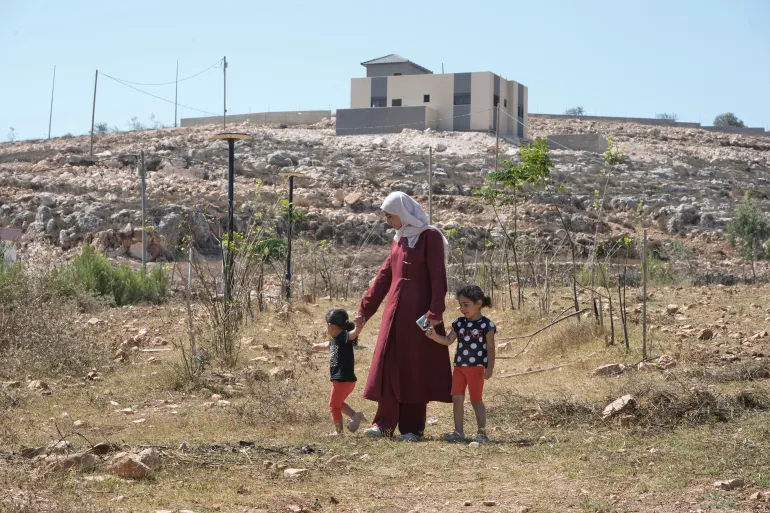
In the village of Qusra in the occupied West Bank, the installation of three new Israeli roadblocks at Ras al-Ain hill has signaled a shift toward a more entrenched siege for local residents. Abdel Hakim Wadi, a local landowner, noted that these barriers—large yellow and orange metal gates anchored in concrete—effectively cut off access to his property and the surrounding area. Such structures have become increasingly common across the West Bank since October 2023, serving as tools for Israeli forces to control movement at the entrances of numerous Palestinian villages.
The situation in this specific sector of Qusra has been critical since August 9, when three homes became the target of a settler-led siege that drew international criticism. Although the Israeli military declared the area a closed military zone, the transition to formal army-controlled gates has not provided relief to the trapped families. Instead, residents describe the move as a strategic shift. “They are pushing the Israeli settlers 100 to 150 metres away from our houses, but now they have established checkpoints,” Wadi explained, describing the development as a “much more permanent siege.”
Among those affected is Loui Ridi, a Palestinian-American from Ohio who returned to Qusra to protect his home. Ridi has been unable to leave his property since arriving on August 17, with Israeli soldiers stationed directly outside. He remains trapped alongside his neighbors, a family that includes two young girls. Ridi expressed frustration with the lack of effective international intervention, stating that while there is talk from the US embassy and the global community, there is no tangible action on the ground to end the blockade.
The placement of the three barriers encircles the summit of the hill, severing it from the lower village and blocking a vital road that connects Qusra to the neighboring villages of Talfit and Jalud. This infrastructure effectively isolates the homes on the hill from the rest of the community. Ridi noted that despite the international condemnation regarding the earlier cutting of water and electricity supplies by settlers, the situation remains dire, with settlers still present in the immediate vicinity while the military enforces the restriction of movement.
For Wadi, the impact is both personal and economic. His nearly one-hectare plot, which contains over 100 olive trees along with almond and fig trees, has been inaccessible since the siege began. The land also features a water well that has been commandeered by settlers. “I see them bathing in the water that they’re taking out from the well,” Wadi said. He fears that even if the military zone designation is eventually lifted, these permanent gates will prevent him from ever returning to his land.
Wadi believes the current military presence is a calculated maneuver to maintain control under the guise of security. “They will put on a show that they have ended the siege but in fact all of what they’re doing is replacing the settlers with the army,” he stated. Ultimately, he views these actions as part of a broader, systematic effort by Israel to seize additional land in the West Bank, piece by piece. The report also notes that if not most villages, and have multiplied since Israel’s genocidal war on Gaza began in October 2023, they’re placed at the entrances of many. The report also notes that the only ones holding the keys are the Israeli forces. The report also notes that forcing Palestinians traveling into the village to take alternative routes – but often find those closed as well, israeli soldiers had already placed a gate at the main entrance of Qusra itself. The report also notes that and now, instead of lifting the siege, the roadblocks erected by the Israelis have been placed in carefully-selected locations. The report also notes that and a third one is to the left side above a house that is being built, another roadblock is slightly further up the hill near a house under construction. The report also notes that in addition to other trees, including almonds and figs, he said that his land – nearly one hectare – is planted with more than 100 olive trees.