

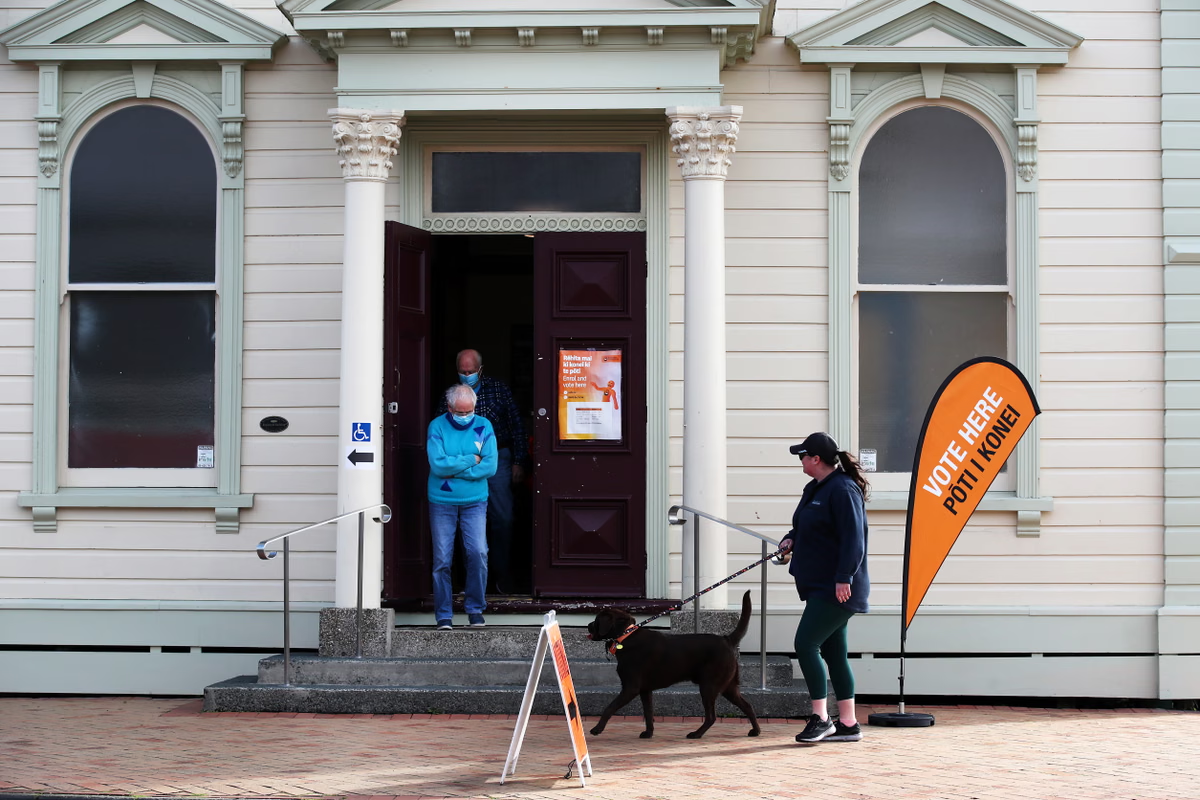
With New Zealand’s general election scheduled for November, the country’s long-standing political duopoly is facing an unprecedented challenge. For decades, the Labour and National parties have alternated in power, but a significant segment of the electorate is now expressing deep dissatisfaction with the status quo. Recent polling indicates that their combined support is at its lowest point in 30 years, reflecting a broader international trend where voters are increasingly gravitating toward smaller, non-traditional parties.
Among those seeking change is 76-year-old Mattie Wall, a former diplomat and project manager. Having historically supported Labour, Wall now feels disillusioned by the traditional political landscape. “In the past, I didn’t feel the frustration I do now with politics,” she said. “I’m so hacked off with both parties, with all parties really. We’ve got Trump 2.0, AI’s sudden surge, increasing climate change impact – what are we waiting for, revolution or societal collapse? Clinging to the old ways ain’t gonna cut it.”
Wall is currently among the 5-8% of voters planning to support the Opportunity party, a group that has never held a parliamentary seat. She finds the party’s platform—which includes a proposed land tax and a $370 weekly universal basic income—to be a pragmatic and necessary shake-up. She specifically praised the party’s leader, Qiulae Wong, describing her as “intelligent, thoughtful, moderate, unpretentious, she speaks lay language and she’s a realist.”
Wong, a 38-year-old sustainability consultant and mother of two who returned to New Zealand from London in 2022, frames her party’s agenda around evidence-based policy and market-driven solutions. She argues that voters are exhausted by “pendulum politics,” where successive governments spend their terms undoing the initiatives of their predecessors. According to Wong, the electorate is searching for stability in areas such as climate legislation, healthcare funding, and education, rather than the constant policy reversals that have hindered national progress.
The Opportunity party’s land tax proposal, which would levy 1.75% on urban land and 0.5% on rural land, is designed to generate NZ$24bn for a citizen’s income while aiming to reduce house prices by 10-15%. While critics like former Labour leader Helen Clark have dismissed the plan as “fantasy posing as policy,” Wong maintains that the economy requires structural change and that the majority of New Zealanders would benefit. She acknowledges the difficulty of immediate implementation but hopes to find common ground with other parties.
Political analyst Richard Shaw of Massey University notes that the shift is driven by a decline in traditional party loyalty. “Voters are less attached to parties than they used to be, and they’re more likely to shop around during elections,” Shaw explained. “They’re peeling off from everywhere; people’s attachment to parties is more elastic and the deep tribalism has gone.” Data from The Post suggests that Opportunity is drawing support from across the spectrum, including 20% of former National voters and 17% of former Labour voters.
The rise of smaller parties is further complicated by New Zealand’s mixed member proportional (MMP) system, introduced in 1996. Under this framework, smaller parties often hold the balance of power. Prime Minister Christopher Luxon, leader of the National party, has explicitly ruled out working with Opportunity. Luxon has also recently floated the idea of a referendum on the MMP system, expressing frustration with the complexities of managing coalition partners, though he denied his comments were directed at his current allies.
Despite the growing interest in alternatives, some voters remain committed to the traditional parties. Christine Hands, 77, who has voted for Labour since 1972, plans to support National this time, viewing them as a “safe pair of hands” that has not caused significant disruption. She remains skeptical of smaller parties, labeling their policies as “mad as a meat axe.”
As the campaign intensifies, the Opportunity party continues to poll above the 5% threshold required to enter parliament. Whether this momentum will translate into a seat at the table remains to be seen, but the current political environment suggests that the era of two-party dominance in New Zealand is becoming increasingly fragile. The report also notes that the apparent rise of Opportunity – a self-described centrist party started three elections ago by economist and philanthropist Gareth Morgan – has injected an unexpected element of drama into the election race. The report also notes that with National’s polling flagging at about 29%, the contest features a weakening right bloc. The report also notes that it means Opportunity could get to choose who governs. The report also notes that the Post newspaper reported Opportunity looks set to nab votes from the right and left. The report also notes that of those who say they will vote Opportunity in November, 20% voted National at the last election, 17% Labour, 12% the Greens and 8% NZ First. The report also notes that voters spoken to by reflected this sentiment. The report also notes that “I don’t understand how a lot of people are surviving right now and that’s what drives my vote,” said Wellingtonian Gemma, 41, a former Green voter who will vote Opportunity for the first time. The report also notes that “Things can’t keep going in this direction.”.