

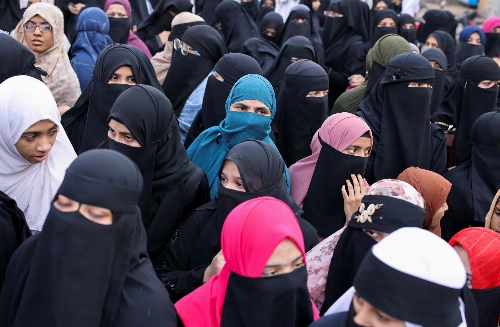
A significant legal ruling by the Allahabad High Court has ignited a widespread political controversy regarding the intersection of institutional dress codes and individual religious expression. The court dismissed a petition filed by a minor student from a private school in Prayagraj, Uttar Pradesh, who had sought permission to wear a headscarf alongside the school’s mandated uniform. The student, who had completed her high school education, was attempting to secure admission to Class 11 at the same institution when the dispute arose.
In its judgment, the High Court clarified that students do not possess the right to unilaterally alter the dress code prescribed by an educational institution to suit their personal preferences. This decision has prompted intense debate concerning the balance between maintaining school discipline and respecting an individual’s right to practice their faith.
The ruling has drawn sharp criticism from several Muslim clerics, who argue that the head covering is a mandatory requirement in Islam. Maulana Khalid Rasheed Farangi Mahli, Chairman of the Islamic Centre of India, stated that the court’s decision requires a formal review and reconsideration. He maintained that the hijab is an integral component of Islamic practice according to the Quran and Hadith, and argued that students wishing to wear a scarf or hijab should not be prohibited from doing so, provided it is worn in conjunction with the uniform.
Echoing these concerns, All India Muslim Jamaat President Maulana Mufti Shahabuddin Razvi Bareilvi suggested that school uniforms and religious attire should be treated as separate matters. He urged legal professionals and judges to consult religious texts to better understand the significance of Islamic practices. Similarly, Maulana Saif Abbas Naqvi, President of the Shia Markazi Chand Committee, noted that while he does not object to the concept of uniforms, he believes the High Court’s verdict should be challenged in the Supreme Court.
The discourse has extended to other religious leaders and activists. Maulana Yasoob Abbas of the All India Shia Personal Law Board emphasized that the Constitution guarantees equal rights to all religions, while Maulana Sajid Rashidi characterized the judgment as an infringement on individual freedom of choice, suggesting the judiciary should prioritize other pending legal matters.
Conversely, the ruling has received support from those who prioritize institutional regulations. Senior advocate and BJP leader Nalin Kohli argued that the decision aligns with various Supreme Court precedents regarding the ‘essential practices’ of a religion. Kohli noted that schools are primarily centers for education rather than religious practice, and that families seeking an education based on specific religious principles have the option to choose institutions that cater to those requirements.
BJP leader Mukhtar Abbas Naqvi also weighed in, cautioning against allowing the issue to escalate into communal tension. He stressed that educational institutions must maintain their own discipline and regulations, which should be respected by all students. This perspective was partially countered by CPI MP P. Santhosh Kumar, who acknowledged the importance of uniforms for equality but argued that students should simultaneously be permitted to retain their religious identity.
As the debate continues, the case highlights the ongoing tension between standardized institutional policies and the diverse religious landscape of India. While the court has affirmed the authority of schools to enforce their dress codes, the pushback from various community leaders indicates that the legal and social conversation surrounding religious attire in educational settings remains far from settled. The report also notes that speaking to reporters, Bareilvi noted: “Within the boundary of a school, the rules and regulations of the institution should be followed. The report also notes that as far as wearing hijab is concerned…its use has been clearly mentioned in Quran. The report also notes that i would request the lawyer and the judges to please refer to the Quran, Hadith (and other religious texts), from where they will get to know about the Islamic practices,” he added. The report also notes that yet, if 10-25 per cent of women do not wear the hijab, we cannot cast them out of the fold of Islam. The report also notes that if a girl wants to go to school wearing a scarf, completely stopping her from doing so, in my view, is absolutely wrong, and the court should reconsider it once again, the question is. The report also notes that i think no one should try to create communal controversy or communal tension in the name of hijab.