

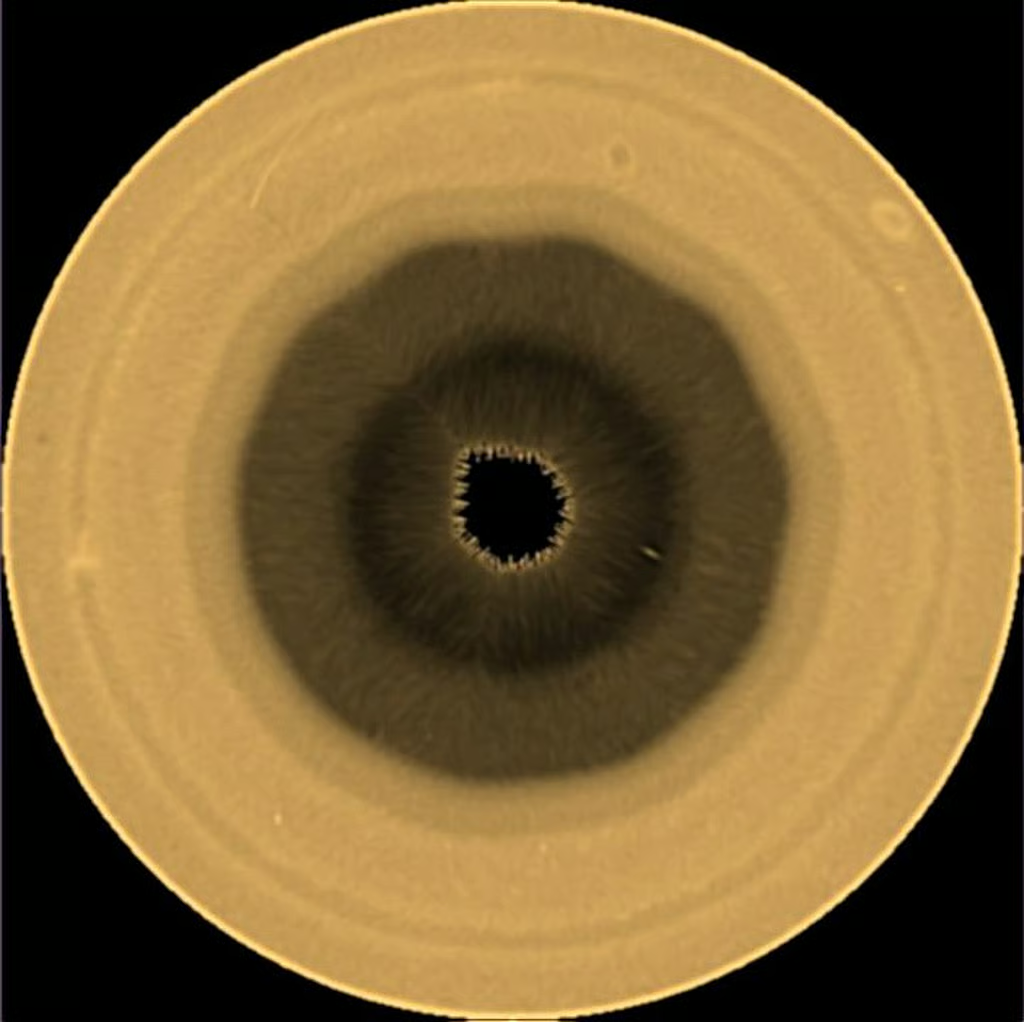
Researchers have identified a massive, 10-sided wave formation swirling within the icy ammonia clouds over Saturn’s south pole. This meandering decagon, which appears both larger and more unstable than the well-documented hexagon observed at the planet’s north pole since the 1980s, was detailed in a study published in the journal Science Advances.
The atmospheric feature was first detected by the Hubble Space Telescope in 2023. Experts believe the phenomenon likely developed between 2017 and 2023, a period when Saturn’s southern hemisphere was tilted away from Earth, obscuring it from view. The structure remains in a state of flux, with individual sides already stretching beyond 16,700 kilometers in length.
Lead author Agustin Sanchez-Lavega of the University of the Basque Country noted that the discovery challenges the notion that the northern hexagon is a singular, extraordinary feature. While both formations are anchored to jet streams, the northern hexagon remains largely stationary, whereas the southern decagon drifts eastward at a speed of approximately 10 kilometers per hour.
Leigh Fletcher from the University of Leicester, who conducted wind measurements for the study using the European Southern Observatory’s Very Large Telescope in Chile, remarked that Saturn continues to defy expectations. Scientists are now investigating why these polygonal shapes are unique to Saturn, with researchers considering potential links to the geometric cyclone arrangements seen on Jupiter.
Future observations of the southern hemisphere are expected to provide further clarity on the decagon’s evolution. It remains uncertain if this formation will persist for decades like its northern counterpart, which has been visible for over 40 years—a duration exceeding a full 30-year Saturnian year. For now, Sanchez-Lavega confirms that the decagon persists in the atmosphere. The report also notes that this new jet stream formation popped up in the Hubble Space Telescope’s sights in 2023 after earlier observations came up empty. The report also notes that with a single side of the decagon already exceeding 16,700 kilometers, it could still be evolving. The report also notes that only Saturn churns them out looking like polygons, geometric shapes bounded by straight lines, although all of the solar system’s planets with atmospheres have wave-spawning disturbances. The report also notes that also Read: After 18 months of effort, Abu Dhabi astronomers image the faint ‘Squid Nebula’.
Mission and Research Updates
- 3I/ATLAS Comet: Currently under observation for 15 distinct anomalies.
- 3I/ATLAS Status: Regarded as a cosmic visitor without a formal trajectory.
- December 2025 Skywatch: A close approach for 3I/ATLAS is officially scheduled.
- Scientific Analysis: Ongoing efforts to debunk myths surrounding the 3I/ATLAS comet.
Technology and Industry Briefs
- AI Readiness: An Indian firm claims to have developed solutions to make legacy PCs AI-capable.
- Climate Research: New studies suggest climate change may be intensifying El Niño events.
- Computing Trends: Debates continue regarding whether the future of AI lies in portable consumer devices.
- Entertainment News: Reports indicate Will Smith is in discussions to portray a villain in an upcoming Allu Arjun film.
Important Details
- The report also notes that 3I/ATLAS: Cosmic tourist who didn’t ask for a visa.
- The report also notes that unmasking myths around 3I/ATLAS: Truth behind the hype.
- The report also notes that get Updates on Topics You Choose.
- The report also notes that got an old PC? India firm says it can make it AI-ready.